

Probiotics and prebiotics work together to support your gut health. Probiotics are live bacteria that help balance your gut, while prebiotics are fibers that feed those bacteria. Taking them together, often called synbiotics, can improve the effectiveness of probiotics by helping them survive and thrive in your digestive system.
Key Points:
- Probiotics: Add helpful bacteria to your gut. Found in foods like yogurt or supplements.
- Prebiotics: Feed the good bacteria already in your gut. Found in foods like garlic, onions, and bananas.
- Synbiotics: Combine both to maximize gut health benefits.
For most people, combining them is safe and effective. However, if you have specific health conditions, consult a healthcare provider to ensure it’s the right choice for you.
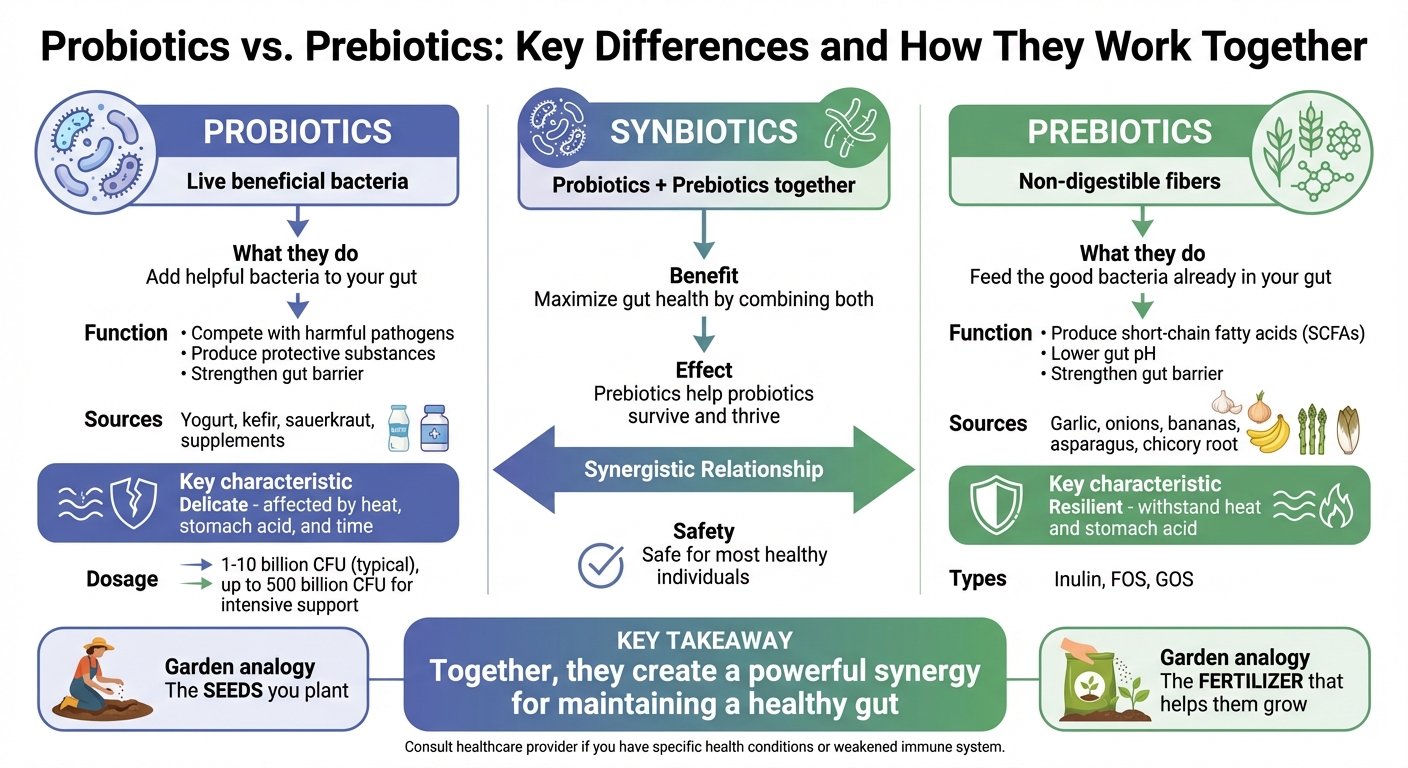
Probiotics vs Prebiotics: Key Differences and How They Work Together
Probiotics vs. Prebiotics: Quick Comparison
What Are Probiotics?
Probiotics are live microorganisms that, when consumed in the right amounts, can support your health. These tiny helpers play a key role in keeping your digestive system balanced. By boosting the community of beneficial bacteria in your gut, probiotics may aid digestion, strengthen your immune system, and help fend off harmful bacteria.
What Are Prebiotics?
Prebiotics, on the other hand, are non-digestible fibers that act as food for the good bacteria already living in your gut. These fibers include compounds like inulin, fructo-oligosaccharides (FOS), and galacto-oligosaccharides (GOS). Since prebiotics are not broken down by your stomach or small intestine, they make their way to the large intestine intact. Once there, they are fermented by gut bacteria, providing the nourishment these microbes need to thrive. This process highlights how prebiotics set the foundation for a healthy gut environment.
Main Differences Between Probiotics and Prebiotics
The simplest way to differentiate them? Probiotics add beneficial bacteria to your gut, while prebiotics feed the ones already there. Gail Cresci, PhD, RD, a microbiome expert at Cleveland Clinic, sums it up well:
"Probiotics are the seeds you plant in your garden (AKA your gut microbiota) and prebiotics are the fertilizer that helps them grow." [1]
Probiotics are more delicate - they can be affected by heat, stomach acid, and time, which may reduce their effectiveness during storage or digestion. Prebiotics, however, are more resilient. They can withstand heat and make it to your colon without breaking down, ready to fuel your gut bacteria. While probiotics work directly by introducing good bacteria and combating harmful pathogens, prebiotics take an indirect approach by selectively feeding and strengthening beneficial microbes. Together, they create a powerful synergy for maintaining a healthy gut and supporting digestion.
How Probiotics Work in Your Gut
How Probiotics Function
Probiotics play a vital role in maintaining gut health by competing with harmful pathogens for both nutrients and adhesion sites in the gut lining [4][3]. They also produce substances like lactic acid and bacteriocins, which are effective in inhibiting the growth of pathogens such as E. coli and Salmonella [4][8].
These beneficial microbes help strengthen the gut's natural barrier by improving the tight junctions between intestinal cells. This prevents harmful compounds and toxins from entering the bloodstream, reducing the risk of inflammation [8]. Probiotics also interact with the immune system by stimulating the production of immunoglobulin A (IgA), enhancing macrophage activity, and balancing cytokine levels to minimize inflammation. Additionally, they produce essential nutrients like B vitamins and short-chain fatty acids, including butyrate, which support overall gut health [4][3][8]. This combination of actions highlights why probiotics are widely studied and recommended for various health benefits.
Where to Get Probiotics
Knowing how probiotics work makes it easier to understand where to find them. Common sources include fermented foods like yogurt, kefir, and sauerkraut. When choosing these, look for labels that indicate "live and active cultures", as pasteurization can destroy the beneficial bacteria [6]. For supplements, most provide 1–10 billion CFU (colony-forming units), but certain health conditions might require higher doses [4]. It’s also important to choose supplements from reputable manufacturers that guarantee the CFU count remains viable through the product’s shelf life [6].
Research-Backed Benefits
Scientific studies have demonstrated the effectiveness of probiotics in managing several conditions. For example, they are beneficial in treating acute infantile diarrhea, antibiotic-associated diarrhea, and traveler’s diarrhea [3]. In children with diarrhea, a dose of around 10 billion CFU within the first 48 hours has shown to be effective [3]. Specific strains like Lactobacillus plantarum or multi-strain formulations can also ease symptoms of IBS, including bloating and flatulence [3].
Probiotics have shown promise in adults with type 2 diabetes as well. A multi-strain probiotic (Ecologic® Barrier), taken at 2.5 × 10^9 CFU twice daily for six months, reduced insulin resistance by 64% and improved the total cholesterol to HDL ratio by 19% [8]. Additionally, Lactobacillus reuteri NCIMB 30242, taken twice daily for six weeks, lowered LDL cholesterol by 8.92% and total cholesterol by 4.81% in individuals with high cholesterol [8]. For adults with type 2 diabetes, multi-strain supplementation also significantly reduced systemic endotoxin levels by 70% [8]. These findings underscore the wide-ranging benefits of probiotics for various health concerns.
How Prebiotics Work in Your Gut
How Prebiotics Function
Prebiotics are a type of non-digestible fiber that travel through your stomach and small intestine without being broken down. Once they reach the colon, they become a food source for beneficial gut bacteria like Bifidobacterium and Lactobacillus [9].
When these fibers are fermented by good bacteria, they produce short-chain fatty acids (SCFAs) such as acetate, propionate, and butyrate [9]. These SCFAs play a key role in gut health. For example, they help lower the pH in the gut, which creates an environment that harmful pathogens find less hospitable. Butyrate, in particular, is a major energy source for the cells lining your colon. This process also promotes a fascinating phenomenon called "cross-feeding", where the byproducts of one beneficial bacterial species become food for another, helping to increase the diversity of your gut microbiome.
Prebiotics also strengthen your gut barrier by increasing tight-junction proteins like zona occludens 1 [8]. This helps prevent what's often referred to as "leaky gut", where harmful substances can pass into the bloodstream. Considering that your gastrointestinal tract is home to about 100 trillion microorganisms, keeping this community balanced is essential for maintaining overall gut health [10].
Where to Get Prebiotics
You don’t need fancy supplements to get your daily dose of prebiotics - plenty of everyday foods are rich in these fibers. For example, inulin is naturally found in chicory root, Jerusalem artichokes, and garlic. Fructooligosaccharides (FOS), another type of prebiotic, are abundant in onions, asparagus, and bananas [10].
Interestingly, about 90% to 95% of dietary polyphenols from foods like cocoa, berries, and green tea bypass absorption in the small intestine and reach the colon, where they may act as prebiotics [9]. Since most Americans consume less than the recommended 25 to 35 grams of fiber per day, gradually adding more prebiotic-rich foods to your meals can make a big difference.
If you prefer supplements, look for products containing inulin, FOS, or galactooligosaccharides (GOS) from trusted manufacturers.
Research-Backed Benefits
The benefits of prebiotics are well-supported by research. For instance, one study found that children who consumed 6 grams of inulin-type fructans daily for 24 weeks experienced a significant increase in Bifidobacteria levels [8]. Another study from Harvard Health revealed that participants consuming 30 grams of plant-based inulin per day for two weeks showed reduced brain activity in areas linked to food cravings when exposed to high-calorie foods, suggesting a potential role in weight management [10].
Prebiotics also enhance mineral absorption. SCFAs produced during fermentation help lower gut pH, improving the solubility and uptake of minerals like calcium and magnesium [9][10]. Additionally, prebiotics interact with immune cells, increasing the production of protective immunoglobulins such as IgA, which supports immune health [8].
"When bacteria are fed what they need to stay healthy, they keep our bodies healthy in return."
– Lisa Catanese, ELS, Harvard Health Publishing [10]
For individuals with specific health conditions, prebiotics show promise. For example, a study involving 10 patients with Crohn’s Disease found that consuming 15 grams of FOS daily was linked to a reduction in disease activity [3]. However, those with diarrhea-predominant IBS or Small Intestinal Bacterial Overgrowth (SIBO) should be cautious when introducing high-prebiotic diets, as these may worsen symptoms [10].
Can You Take Probiotics and Prebiotics Together?
Safety and Results
Yes, for most healthy individuals, taking probiotics and prebiotics together is considered safe. This pairing creates a synergistic effect where prebiotics act as a food source, helping probiotics survive and thrive in the gut [11][1]. However, people with weakened immune systems, those on immunosuppressants, or individuals with severe health conditions should avoid these supplements. In such cases, there’s a risk of harmful bacterial overgrowth or other complications [6]. For a more targeted approach, synbiotic formulations combine these two components for enhanced effectiveness.
What Are Synbiotics?
Synbiotics are specially crafted products that combine probiotics and prebiotics into a single formulation. These are designed to improve the survival and implantation of beneficial bacteria as they make their way through the gastrointestinal tract [4][3]. According to the Institute of Fermentation Technology and Microbiology:
"Synbiotics were created in order to overcome some possible difficulties in the survival of probiotics in the gastrointestinal tract" [4].
One example is Begin Rebirth RE-1™, a 3-in-1 eubiotic synbiotic that combines probiotics, prebiotics, and postbiotics to support gut health. With 500 billion CFU per serving and featuring Human Origin Strains (HOSt™), it’s designed to quickly restore gut microbiome balance. It also contains 4.5 grams of fiber from GOS and inulin, delivered via the Lyosublime™ system for better absorption - plus, it doesn’t require refrigeration.
How to Combine Them
To maximize the benefits of probiotics and prebiotics, start with small doses to allow your gut to adjust and minimize discomfort. A practical way to combine them is by taking probiotic supplements alongside prebiotic-rich foods like bananas, garlic, or oats. These foods provide an immediate energy source for the probiotics [2]. However, individuals with conditions like Irritable Bowel Syndrome (IBS) or Small Intestinal Bacterial Overgrowth (SIBO) should consult a healthcare provider first, as prebiotics can sometimes worsen symptoms like gas or bloating in these cases [2][11].
When choosing supplements, look for products with independent testing seals to ensure quality and potency [1]. Be aware that early use may lead to temporary side effects such as gas, constipation, loose stools, or acid reflux, but these usually subside as your body adapts [7].
sbb-itb-1bbfe7f
How to Choose Probiotics and Prebiotics
Selecting Probiotics
When choosing probiotics, it's important to check for specific details like the genus, species, and strain of the bacteria. For example, a high-quality product might list Lactobacillus rhamnosus GG. Why is this level of detail so important? According to research from the Institute of Fermentation Technology and Microbiology:
"Probiotic characteristics are not associated with the genus or species of a microorganism, but with few and specially selected strains of a particular species." [4]
This means that the benefits of probiotics are tied to specific strains, not just the general category of bacteria.
Another key factor is the CFU (colony-forming units) count, which should be guaranteed at the product's expiration date. This ensures you're getting live bacteria when you use it. Clinical studies suggest that at least 10 billion CFU within the first 48 hours is the minimum effective dose for treating acute infantile diarrhea [3]. To ensure accuracy, look for third-party verification seals on the packaging.
Storage requirements also matter. While some probiotics need refrigeration, others, like spore-forming strains such as Bacillus coagulans, are shelf-stable and better equipped to survive stomach acid. Tailor your choice to your specific health needs. For example:
- Saccharomyces boulardii: Helpful for antibiotic-associated diarrhea.
- Bifidobacterium lactis: May relieve constipation.
- Lactobacillus plantarum: Often used for IBS symptoms.
Selecting Prebiotics
Prebiotics, which are essentially food for beneficial bacteria, are another important piece of the puzzle. Look for types like inulin, FOS (fructooligosaccharides), or GOS (galactooligosaccharides), which selectively nourish good bacteria like Bifidobacterium.
If you're new to prebiotics or increasing your intake of fiber-rich foods, take it slow. Gradually ramping up your consumption can help you avoid uncomfortable side effects like gas or bloating.
Using Both Together
Combining probiotics and prebiotics is a smart way to maximize gut health. Prebiotics help probiotics thrive, making them more effective. For example, you can pair a probiotic supplement with a prebiotic-rich meal or opt for a synbiotic product that combines both. As Gail Cresci, PhD, RD, from Cleveland Clinic explains:
"A probiotic in a capsule may not survive while sitting on the grocery store shelf or passing through your intestinal tract. But when you combine it with its food source, the prebiotic, it has a much better shot at staying viable." [1]
Synbiotic products are designed with this synergy in mind, but whether you choose a combined product or use separate probiotics and prebiotics, consistency is key. Regular use can help maintain a balanced and healthy gut.
Probiotics vs. Prebiotics: What’s the Real Difference?
Conclusion
Probiotics and prebiotics play complementary roles in keeping your gut in check. Probiotics introduce helpful bacteria into your gut, while prebiotics act as their fuel, offering the necessary fibers to keep these microbes thriving.
When used together, these two can work even better. Prebiotics not only nourish probiotics but also help them survive the journey through your digestive system. For most healthy individuals, combining them is safe and can be more effective than using them separately. For example, research indicates that probiotics can cut the risk of antibiotic-associated diarrhea by nearly half in non-hospitalized patients [5].
Products like synbiotic formulas combine the best of both worlds by packaging probiotics and prebiotics into one solution. A great example is Begin Rebirth RE-1™, a synbiotic designed to promote a balanced gut microbiome.
FAQs
What are the benefits of using synbiotics for gut health?
Synbiotics are a combination of probiotics (live beneficial bacteria) and prebiotics (nutrients that nourish those bacteria), working together to enhance gut health. Think of it as planting seeds (probiotics) and providing the fertilizer (prebiotics) they need to grow. This dynamic duo helps beneficial bacteria flourish, promoting a balanced gut microbiome.
Studies suggest synbiotics can:
- Improve digestive health by easing bloating, constipation, and diarrhea while supporting regularity.
- Strengthen immune function by modulating immune responses and reducing inflammation.
- Rebalance the microbiome in cases of dysbiosis, irritable bowel syndrome, and metabolic challenges.
By addressing both the beneficial microbes and their nourishment, synbiotics offer a fast and effective way to reset gut health. Begin Rebirth RE-1™, a clinically-supported synbiotic, is designed to restore balance, enhance immune health, and tackle microbiome imbalances efficiently.
Are there any side effects when taking probiotics and prebiotics?
For most healthy adults, taking probiotics, prebiotics, or a combination of both (known as synbiotics) is generally considered safe. That said, you might notice mild digestive symptoms like gas, bloating, abdominal discomfort, or temporary changes in bowel habits, such as constipation or loose stools. These are usually short-lived and tend to disappear within a few days to a week as your gut adjusts.
While serious side effects are uncommon, they can happen in certain high-risk groups. People with severely weakened immune systems, those recovering from recent abdominal surgery, or individuals with critical illnesses should be cautious. If you fall into one of these categories, it’s essential to consult a healthcare provider before starting any supplements. Additionally, if you experience severe abdominal pain, a fever, or ongoing diarrhea, it's wise to seek medical advice.
For the majority of people, when used as directed, probiotics and prebiotics are well-tolerated and can contribute to better gut health.
Can I take probiotics and prebiotics together, and how do I choose the right combination?
Yes, you can take probiotics and prebiotics together, and combining them can amplify their effects. To get the most out of this pairing, start by identifying your specific health needs - whether it’s better digestion, stronger immunity, or addressing gut imbalances. When selecting a probiotic, look for supplements that specify strains like Lactobacillus rhamnosus GG or Bifidobacterium longum BB536, as their benefits depend on the strain. Aim for a product with a colony-forming unit (CFU) count between 10 billion and 100 billion per serving, and make sure the potency is guaranteed through the expiration date.
To complement your probiotic, choose a prebiotic that feeds beneficial bacteria. Options like inulin, FOS, or resistant starch work well, and a daily intake of 3–5 grams of prebiotic fiber is a good target. You can also get probiotics from foods like yogurt, kefir, or kimchi, and prebiotics from fiber-rich options such as bananas, oats, and legumes.
For a more streamlined approach, consider a synbiotic - a single product that combines probiotics and prebiotics in precise amounts. A great example is Begin Rebirth RE-1™, which offers a 3-in-1 formula with probiotics, prebiotics, and postbiotics to promote quick microbiome balance. Products like this ensure the prebiotics are tailored to support the included probiotic strains, enhancing their combined effectiveness.