


Sleep disruption, diet, and antibiotics all impact your gut microbiome - but in different ways. Sleep loss can reduce microbial diversity by 21% in just three nights, while a Western-style diet disrupts bacterial rhythms and promotes weight gain. Antibiotics, on the other hand, cause the most severe and long-lasting damage, wiping out beneficial microbes with recovery taking months or even years.
Key Takeaways:
- Sleep Loss: Affects gut bacteria within 24–48 hours; reversible with consistent rest.
- Western-Style Diet: Alters gut composition quickly; improves with dietary changes.
- Antibiotics: Drastically reduce microbial diversity; recovery is slow and sometimes incomplete.
Your gut health is closely tied to sleep, diet, and medication use. Prioritize consistent sleep, a nutrient-rich diet, and cautious antibiotic use to maintain microbial balance.
1. Sleep Disruption
Timeframe to Diversity Change
Sleep deprivation starts to affect gut microbiota surprisingly fast - within just 24 to 48 hours [10][11][13]. In fact, functional changes, like shifts in how bacteria process energy and amino acids, can occur within the first day, even before noticeable changes in the types of bacteria present [13].
Between February 2018 and April 2019, researchers at the Natick Soldier Systems Center studied 19 healthy men with an average BMI of 24.4 kg/m². These participants were restricted to just 2 hours of sleep per night for three consecutive nights. The results? A 21% drop in gut microbiota richness compared to when they got adequate sleep (7–9 hours per night). Interestingly, while the richness decreased, the overall composition of the microbiota remained relatively stable in the short term [9].
Even minor shifts in sleep timing can impact gut diversity. A 30-day study with 26 men revealed that better sleep efficiency was positively linked to microbiome richness (ρ = 0.479) and Shannon diversity (ρ = 0.643). Experts noted that even small changes in sleep patterns could influence bacterial species variation [14].
Magnitude of Diversity Loss
The severity of gut diversity loss depends on how extreme and prolonged the sleep disruption is. Total sleep deprivation has a more pronounced effect than partial restriction. For instance, a study published in Nature and Science of Sleep examined rats subjected to 48 hours of total sleep deprivation. While microbial composition didn’t change much at the 24-hour mark, significant reductions in both alpha and beta diversity were evident after 48 hours [13].
Chronic sleep fragmentation causes even more dramatic shifts. In a study where mice experienced fragmented sleep for 4 weeks, the ratio of Firmicutes to Bacteroidetes increased from 1.0 to 1.7. This was accompanied by a 20% rise in Firmicutes and a 50% drop in Actinobacteria. Beneficial families like Lactobacillaceae and Bifidobacteriaceae were nearly halved during this period [7].
"Alpha (α) diversity experiences a dramatical decrease in the SD group compared with the control group." – Sun et al., Yangzhou University [10]
These findings emphasize how quickly and significantly sleep disruptions can affect gut health, though recovery is often possible once normal sleep patterns resume.
Reversibility
The good news? Many of the changes caused by sleep deprivation can bounce back quickly. In mice subjected to 4 weeks of fragmented sleep, a 2-week recovery period restored levels of beneficial bacteria like Lachnospiraceae (p < 0.002 during fragmentation) and Lactobacillaceae (p = 0.0033 during fragmentation) to near-normal levels (p = 0.44 and p = 0.17, respectively) [7]. However, while bacterial populations may recover, some functional metabolic changes might take longer to return to baseline [13].
Health Impact
The loss of beneficial bacteria, such as Lachnospiraceae and Butyricicoccus, can have serious consequences. These bacteria are vital for producing short-chain fatty acids, which help maintain gut barrier integrity. When their levels drop, it can lead to a weaker gut barrier and higher levels of inflammatory markers like IL-6 and TNF-α [10][13].
Sleep disruption is also closely tied to "leaky gut", a condition where the gut barrier becomes compromised, allowing harmful molecules like lipopolysaccharides (LPS) to enter the bloodstream [1][7]. This process can trigger a cascade of issues, including insulin resistance, systemic inflammation, and obesity. The effects don’t stop there - these disruptions can also impact the brain through the gut-brain axis, potentially worsening conditions like depression, anxiety, and cognitive decline [8]. Additionally, the natural rhythms of gut bacteria are thrown off, further impairing metabolic regulation [1][3].
2. Western-Style Diet
How Quickly Does It Affect Gut Diversity?
Unlike sleep loss, which only slightly reduces gut microbial diversity over several nights, a Western-style diet can trigger notable changes in just a matter of days [15][5]. High-fat diets, for example, can disrupt the natural daily rhythms of beneficial gut metabolites like butyrate and propionate in no time [2]. This rapid shift highlights how profoundly diet can influence gut health. Let’s dig into just how significant these changes can be.
The Extent of Gut Diversity Loss
Western-style diets, rich in fats and sugars, cause a marked shift in gut composition. Specifically, they increase the Firmicutes-to-Bacteroidetes (F:B) ratio - a key indicator of microbial imbalance. Chronic consumption of these diets can raise Firmicutes levels by about 20% while reducing beneficial Actinobacteria [7]. This imbalance has real consequences:
"A 20% increment of Firmicutes with a corresponding Bacteroidetes decrease in humans could lead to the acquirement of 150 kilocalories." – Jingyi Sun et al., College of Veterinary Medicine, Yangzhou University [6]
In practical terms, this extra 150 kilocalories per day could contribute to long-term weight gain and related health issues. Compared to sleep disruption, which has a milder and more stable effect on gut composition, dietary changes consistently drive more pronounced microbial and functional shifts [5][9].
Can These Changes Be Reversed?
Here’s the silver lining: the gut imbalances caused by a Western-style diet are generally reversible. Making deliberate dietary changes - like adding more prebiotics (non-digestible fibers), consuming probiotics (beneficial bacteria), and losing weight - can lower the F:B ratio and help restore microbial harmony [15][2].
"Dietary adjustments may be used to permanently alter the composition of the gut microbiota." – Vignesh S D, Department of Pharmacy Practice, SRM College of Pharmacy [15]
Animal studies show that even severe gut disruptions caused by poor diets can return to baseline once a healthier eating pattern is resumed. Remarkably, this rebalancing can happen in as little as two weeks.
The Broader Health Consequences
A Western-style diet doesn’t just change which bacteria thrive in your gut - it also impacts how these microbes function. For instance, the loss of bacteria that produce short-chain fatty acids (SCFAs) weakens the gut’s protective barrier, paving the way for inflammation and metabolic problems [15][6]. These changes are linked to obesity, Type 2 diabetes, and cardiovascular diseases.
Adding to the concern, an imbalanced microbiome that extracts an extra 150 kilocalories daily can further increase the risk of metabolic disorders. While these effects are reversible, they highlight how diet-induced gut changes can worsen gut barrier dysfunction - a problem also seen with sleep loss. Interestingly, the two factors often interact: poor sleep can lead to overeating, which then amplifies the damage caused by unhealthy dietary choices [7][6].
3. Antibiotics
Timeframe to Diversity Change
Unlike dietary changes, which gradually influence gut diversity, antibiotics have a much faster and more intense effect. Within just a week of starting a course, antibiotics can drastically reduce microbial richness and diversity in the gut [16].
Magnitude of Diversity Loss
The loss of gut diversity caused by antibiotics is staggering. Broad-spectrum antibiotics, in particular, can wipe out entire groups of beneficial microbes, a phenomenon researchers call "microbiome depletion" [4]. In studies with mice, prolonged treatment with broad-spectrum antibiotics led to a 100,000-fold reduction in intestinal bacteria [17].
Reversibility
Recovering from the gut disturbances caused by antibiotics often takes a long time - and in many cases, recovery is incomplete. For example, a seven-day course of clindamycin can cause a sharp decline in Bacteroides populations, and this decline can persist for up to two years [16]. Similarly, beneficial bacteria like Bifidobacterium may take an entire year to return to normal levels [16].
Interestingly, lifestyle factors can affect the recovery process. Consistent sleep and eating schedules seem to help the microbiome bounce back faster, while disrupted routines can severely delay or even prevent full recovery. A study from Vanderbilt University in November 2022 showed that mice with stable daily schedules regained their microbiome composition within six months of a five-day antibiotic course. In contrast, mice with irregular activity patterns failed to recover fully, even after eight additional weeks under normal conditions [18].
"The composition of the microbiome recovers to pretreatment conditions when exposed to consistent daily rhythmicity, whereas in hosts whose feeding and activity patterns are temporally disrupted, microbiotal recovery is incomplete." – C. Zhao et al., Vanderbilt University [18]
These prolonged disruptions can lead to serious health consequences.
Health Impact
The depletion of beneficial bacteria by antibiotics has ripple effects on overall health. It can reduce intestinal serotonin production and lower vitamin B6 levels [17]. This disruption weakens the gut's protective barrier and interferes with metabolic signaling throughout the body [4]. Antibiotic use also increases the risk of C. difficile infections and promotes the development of antibiotic-resistant strains [16].
"Antibiotic-induced changes in microbial composition can have a negative impact on host health including reduced microbial diversity, changes in functional attributes of the microbiota, [and] formation and selection of antibiotic-resistant strains." – Dhrati V Patangia, School of Microbiology, University College Cork [16]
Alarmingly, up to 35% of women in Western countries are exposed to antibiotics during pregnancy and delivery [16], highlighting how common this issue is.
sbb-itb-1bbfe7f
How Sleep and Circadian Rhythms Shape Gastrointestinal Health
Pros and Cons
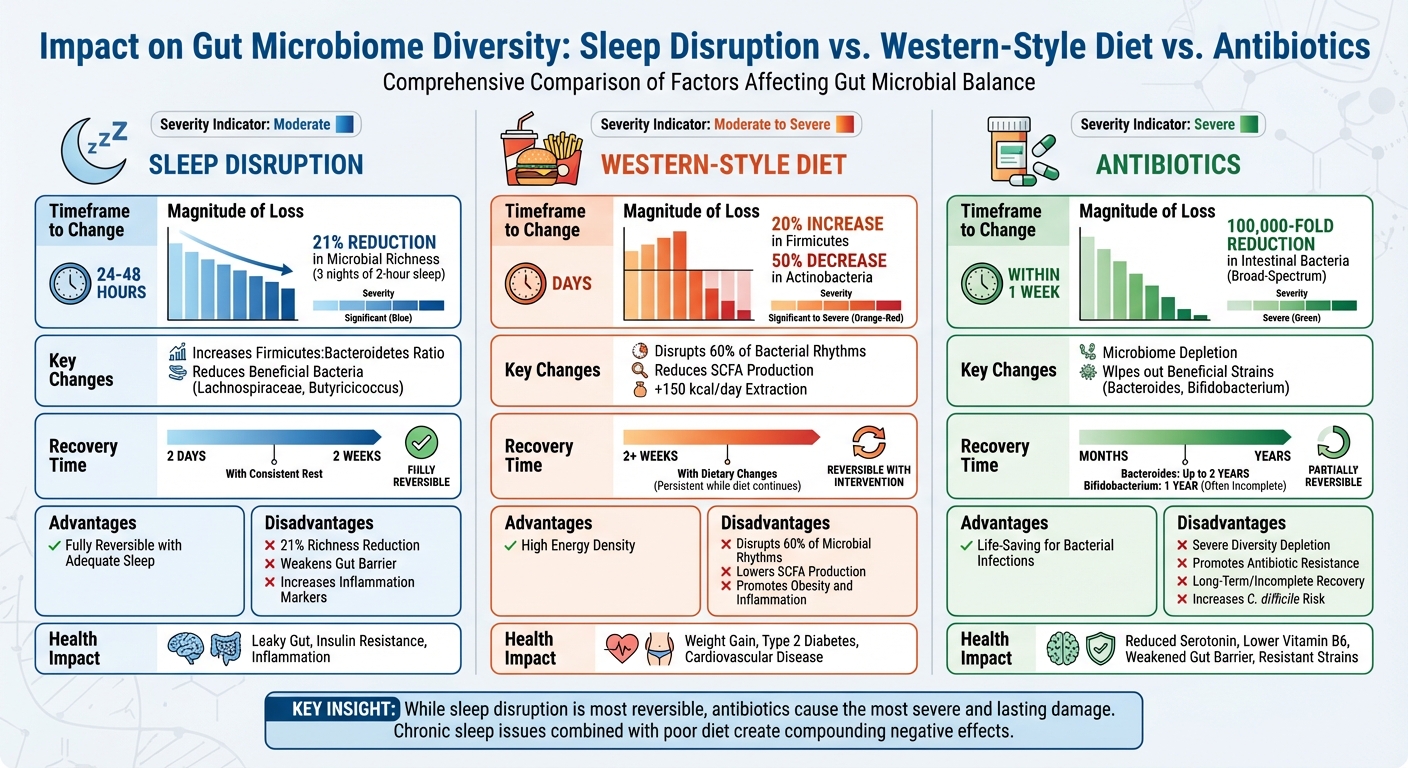
Sleep, Diet, and Antibiotics Impact on Gut Microbiome Diversity
When looking at the effects of sleep loss, diet, and antibiotics on the gut microbiome, it's clear they each have unique impacts in terms of severity and how easily the microbiome can bounce back. Here's a closer look at the trade-offs of these factors.
Sleep disruption has one key upside: its effects are often reversible, with recovery starting as quickly as two days after consistent rest [2]. But the downsides are no small matter. Chronic sleep deprivation can slash microbial richness by 21% - as seen in a study where participants were restricted to two hours of sleep for three nights [9]. It also shifts the Firmicutes-to-Bacteroidetes (F:B) ratio, which is linked to obesity and metabolic problems [12]. On top of that, sleep loss weakens the intestinal barrier by reducing protective mucus (MUC2) and goblet cells, potentially leading to systemic inflammation [6].
A Western-style diet doesn’t really offer any benefits for the gut microbiome. Its only real "advantage" is its high caloric density, which might have been useful in evolutionary terms but now contributes to metabolic issues [6]. The downsides are both serious and long-lasting. This diet disrupts the natural daily rhythms of up to 60% of gut bacteria [3], reduces the production of beneficial short-chain fatty acids (SCFAs), and lowers both alpha and beta diversity [12]. These effects can lead to chronic inflammation, weight gain, and insulin resistance [2], and they persist as long as the diet remains unchanged.
Antibiotics, while crucial for treating infections and saving lives [16], come with significant drawbacks. They rapidly deplete both harmful and beneficial microbes [4], and the loss of diversity can last for months or even years. Some beneficial strains may never fully recover [16]. Additionally, antibiotics can promote the development of resistant bacteria and increase the risk of infections like Clostridium difficile [16].
Here’s a quick comparison of these factors:
| Factor | Advantages | Disadvantages | Recovery Time |
|---|---|---|---|
| Sleep Disruption | Effects are reversible with adequate rest [7] | Reduces microbial richness by up to 21%, increases F:B ratio, weakens barrier [9][6] | Recovery can start within 2 days [2] |
| Western-Style Diet | High energy density [6] | Disrupts microbial rhythms, lowers SCFA production, promotes obesity [3][12] | Persistent as long as diet continues [2] |
| Antibiotics | Life-saving for infections [16] | Depletes diversity, promotes resistance, long-term metabolic effects [16][4] | Months to years; sometimes incomplete [16] |
While all three factors negatively affect gut microbial diversity, antibiotics and Western-style diets tend to cause deeper and more enduring damage than short-term sleep disruption [5][7]. However, chronic sleep issues - especially when paired with a poor diet - can create a compounding negative impact on gut health over time [14].
Conclusion
Sleep disruption, Western-style diets, and antibiotics all take a toll on gut microbial diversity, but the way they affect it - along with how quickly and severely - varies. For instance, while short-term sleep loss can be remedied with proper rest, chronic deprivation is a bigger issue. It can lead to a staggering 21% decrease in microbial richness and trigger metabolic shifts similar to those caused by high-fat diets [9][7].
Keeping a consistent sleep schedule is crucial. Even shifting your sleep midpoint by just 90 minutes between weekdays and weekends can promote the growth of bacteria linked to negative health outcomes [14]. Aim for 7 to 9 hours of sleep each night - something over 35% of U.S. adults fail to achieve [2]. Aligning your sleep with regular meal timing can also help restore your gut’s natural rhythm.
Time-restricted feeding, where you limit eating to an 8-hour window, is another effective way to re-align gut bacteria rhythms [3]. Pairing this approach with a nutrient-dense diet, as outlined by the DI-GM framework, can further improve both sleep quality and gut health [19].
For those dealing with severe gut imbalances or aiming for quicker recovery, targeted microbiome support can make a difference. Begin Rebirth RE-1™ is a clinically supported 3-in-1 synbiotic that delivers 500 billion CFU per serving, featuring Human Origin Strains (HOSt™). It’s available in 7-day, 4-week, and 12-week protocols designed to restore microbial balance effectively.
"Sleep is a key pillar of health... Even a 90-minute difference in the midpoint of sleep can encourage microbiota species which have unfavorable associations with your health." – Dr. Kate Bermingham, ZOE [14]
FAQs
How does disrupted sleep affect gut microbial diversity?
Sleep troubles - whether caused by insomnia, shift work, or cutting back on sleep - can take a toll on the diversity and balance of your gut bacteria. Research reveals that even a few nights of severe sleep deprivation (like getting just 2 hours of sleep per night for three nights) can slash microbial diversity by about 21%. While the overall balance might not seem drastically affected at first glance, specific bacterial groups, such as those in the Ruminococcaceae family, can experience noticeable changes. This shows just how sensitive the gut microbiome is to sleep loss.
When sleep disturbances become a long-term issue, the effects are even more concerning. Chronic sleep issues can reduce microbiome diversity further, paving the way for harmful bacteria to thrive. This imbalance, known as dysbiosis, has been linked to problems like inflammation, insulin resistance, and a weakened immune response. Rebuilding a diverse gut microbiome is critical for maintaining good health. Begin Rebirth RE-1™ provides a clinically-supported synbiotic solution to help restore gut diversity and aid in recovery from sleep-related disruptions to your microbiome.
Can changing your diet help restore gut health affected by a Western diet?
Yes, adjusting your diet can play a big role in improving gut health, especially if it's been affected by a typical Western diet. Incorporating more high-fiber, prebiotic-rich foods - like whole grains, legumes, fruits, and resistant starches - can encourage the growth of beneficial gut bacteria. This, in turn, helps enhance microbial diversity, which tends to suffer in diets high in fat and low in fiber.
Studies also indicate that a fiber-rich diet can have a positive impact on the gut-brain connection, potentially boosting sleep quality and metabolic health. Cutting back on saturated fats and prioritizing plant-based nutrients can further help maintain a balanced gut microbiome. These changes not only counter some of the harmful effects of Western eating habits but also support better overall health in the long run.
How do antibiotics affect the diversity of the gut microbiome over time?
Antibiotics can have a profound impact on the gut microbiome, often causing a sharp decline in bacterial diversity within just weeks of use. Some beneficial bacteria, such as Bacteroides and Clostridia, may face challenges in bouncing back even months after antibiotic treatment. This imbalance can leave the gut more vulnerable to infections, disrupt metabolic processes, and interfere with immune system function.
Prolonged antibiotic use, particularly during early life, can lead to lasting shifts in the microbiome. These changes may include a drop in the production of essential compounds like short-chain fatty acids and an increased risk of chronic conditions such as obesity, inflammatory bowel disease, and allergies. Restoring microbial diversity plays a key role in recovering gut health. Products like Begin Rebirth RE-1™, a synbiotic supported by clinical research, can aid in replenishing beneficial bacteria and rebalancing the microbiome in as little as 7 to 12 weeks.