


Meal timing isn't just about when you eat - it directly influences your gut microbiome and overall health. Your gut bacteria follow 24-hour cycles, and irregular eating patterns, like late-night snacking or shift work, can disrupt these rhythms. This misalignment can lead to issues like inflammation, leaky gut, and even increase the risk of obesity and metabolic syndrome by 40–60%.
Here’s what you need to know:
- Consistent meal timing helps maintain gut microbial diversity and supports digestion.
- Early Time-Restricted Feeding (eTRF) (eating most calories before 2:00 PM) aligns with your body’s natural rhythms, promoting better gut health and metabolic outcomes.
- Late-night eating disrupts microbial balance, reduces diversity, and weakens the gut barrier.
- Time-Restricted Eating (TRE) and Intermittent Fasting (IF) can restore microbial rhythms, boosting beneficial bacteria and improving gut integrity.
The interplay between gut microbiota, diet, and circadian rhythms, with Dr. Vanessa Leone PhD
Understanding Chrononutrition
Chrononutrition looks at how the timing of your meals aligns with your body's internal biological clocks, influencing both metabolic and digestive health [2][4]. Instead of just focusing on what you eat, this field explores when you eat and how that timing interacts with your circadian rhythms and gut microbiome.
Research shows that your gut microbiome and circadian system work as a connected network rather than independently [7]. Your body's internal clock influences the makeup of your gut bacteria through cycles of eating and fasting, while those same bacteria produce metabolites that help synchronize the body's peripheral clocks [2][7]. Interestingly, the circadian clock impacts up to 80% of mammalian protein-coding genes [7], highlighting how meal timing plays a crucial role in overall health. This connection opens the door to understanding how daily hormonal and physiological cycles shape microbial behavior.
How Circadian Rhythms Affect Gut Microbiome
Your circadian system impacts your gut microbiome in several ways, including eating and fasting cycles, intestinal movement, body temperature changes, and hormone release (like melatonin and glucocorticoids) [7]. These rhythms create patterns in the microbiome, with over 50% of microbial composition shifting in a predictable 24-hour cycle [2].
During active feeding phases, bacterial diversity and total load tend to peak, with microbes moving closer to the intestinal wall. For example, Firmicutes levels are highest near the end of feeding periods. On the other hand, during fasting, Bacteroidetes increase as they shift to digesting host mucus when dietary nutrients are limited [8][3]. A normal feeding pattern results in a Firmicutes ratio of 3:1, but this balance flattens to 1:1 with a high-fat diet [3].
Gut bacteria communicate with the body through metabolites. Short-chain fatty acids like butyrate, along with secondary bile acids, can influence the expression of core clock genes via epigenetic mechanisms [7]. In humans, fecal levels of acetate, propionate, and butyrate decrease throughout the day [5]. These daily cycles directly affect the diversity and functionality of gut bacteria.
Meal Timing and Microbial Diversity
Sticking to consistent meal times is key to maintaining microbial diversity and gut barrier health. About 15% of bacterial species - making up as much as 60% of the microbiome - follow rhythmic fluctuations [8].
Irregular eating schedules, like those experienced by shift workers or during late-night meals, can disrupt these natural rhythms. This disruption impacts gut barrier integrity by altering tight junction proteins, which are vital for maintaining gut health [4][7]. Regular meal timing helps regulate these proteins and supports a healthy microbiome.
"Chrononutrition is a promising non-pharmacological approach to preventing metabolic dysregulation and promoting gut health." - PubMed [4]
The timing of your largest meal also plays a role. A 2018 study conducted at the University of Murcia in Spain observed 10 healthy women who ate a large lunch at either 2:00 PM or 5:30 PM. The results showed that eating the main meal later in the day disrupted the daily rhythm of salivary microbiota diversity and increased pro-inflammatory bacteria within just one week [9][10].
Recent Studies on Meal Timing and Gut Microbiome
Recent controlled trials reveal that when we eat can significantly influence gut bacteria and metabolic health. Below, we explore key research that sheds light on these effects.
Early Time-Restricted Feeding (eTRF)
A study conducted from March to June 2023 at the University of Primorska examined the impact of early time-restricted eating (8:00 AM–4:00 PM) compared to late time-restricted eating (12:00 PM–8:00 PM), both under energy restriction. The findings were striking: participants in the early eating group saw an increase in beneficial bacteria like Faecalibacterium and Subdoligranulum. They also experienced lower fasting glucose levels, reduced diastolic blood pressure, and a significant drop in the Bacillota-to-Bacteroidota ratio - a marker often tied to better metabolic health [12].
"eTRE + ER may promote beneficial, lasting shifts in the gut microbiome associated with improved metabolic outcomes." - Bernarda Habe, Faculty of Health Science, University of Primorska [12]
Further support for these findings comes from a study involving 30 young men in Nanjing. Over 25 days, a 16-hour fasting regimen led to increased levels of _Prevotella_9, Faecalibacterium, and Dialister, while the control group showed higher proportions of Bacteroides and Escherichia-Shigella [14]. These shifts align closely with the body’s natural circadian rhythms, promoting microbial diversity and strengthening the gut barrier.
Late-Night Eating Effects
On the flip side, late-night eating poses challenges for gut health. A 2025 study by the University of Primorska found that late-time eating combined with energy restriction resulted in the greatest decline in microbial diversity when compared to early eating windows or energy restriction alone. The Shannon index, a measure of microbial diversity, showed a significant decrease (F = 5.72, p < 0.001) in the late-eating group [12].
Late-night eating also increased levels of bacteria such as Turicibacter, Coprococcus, Lachnospira, and Roseburia. These changes disrupt the gut's natural rhythms, reduce microbial diversity, and weaken gut barrier integrity [1][4].
Short-Term Meal Timing Changes
Short-term adjustments to meal timing - lasting just 7 to 9 days - appear to have limited impact on the gut microbiome. This underscores the importance of maintaining consistent eating patterns over the long term to achieve meaningful changes. For example, studies indicate that sticking to an early eating window for several months can encourage the growth of beneficial bacteria like Faecalibacterium [12][13][15].
While quick fixes may not yield dramatic results, sustained dietary habits clearly play a critical role in reshaping the gut microbiome and supporting overall health.
sbb-itb-1bbfe7f
Time-Restricted Eating and Intermittent Fasting
As mentioned earlier, syncing your meals with your body’s circadian rhythm plays a key role in gut health. Time-restricted eating (TRE) and intermittent fasting (IF) take this concept further by offering a structured approach to meal timing. These methods aim to restore the natural daily cycles of gut bacteria, which can be thrown off by irregular eating habits or high-fat diets [16][17].
The human gut microbiome is incredibly complex, with genes outnumbering those in the human genome by about 150 to 1 [16]. TRE and IF allow these trillions of microbes to follow their natural rhythms. Popular fasting patterns include the 16:8 method (16 hours of fasting with an 8-hour eating window) and the 14:10 method [17][14]. By sticking to a set eating window, TRE encourages a steady microbial rhythm that aligns with the body’s internal clock.
Research Findings from TRE and Fasting Studies
Studies show that TRE can enhance the richness and diversity of gut microbes, with results varying based on the fasting duration and length of the intervention [16][14][18]. For instance, research from Nanjing highlights that a 16-hour fasting window increases beneficial gut bacteria [14].
"Feeding–fasting cycles shape gut microbial composition and metabolite production. These alterations may play a causative role in driving the cardiometabolic benefits of intermittent fasting."
– Karina Ratiner, Systems Immunology Department, Weizmann Institute of Science [17]
TRE also supports gut health by boosting the production of short-chain fatty acids (SCFAs) like butyrate and acetate. These compounds provide energy to intestinal cells and help fortify the gut’s protective mucosal barrier [16][17]. Bacteria like Faecalibacterium, Akkermansia muciniphila, and Prevotella - often increased through TRE - are linked to better metabolic health and reduced inflammation [14][12][17]. A systematic review from 2024 further emphasized that while IF generally improves microbial diversity, the specific outcomes depend on individual factors and the chosen fasting protocol [18]. These findings underscore the importance of consistent meal timing for maintaining a balanced gut microbiome.
Applying Meal Timing for Better Digestive Health
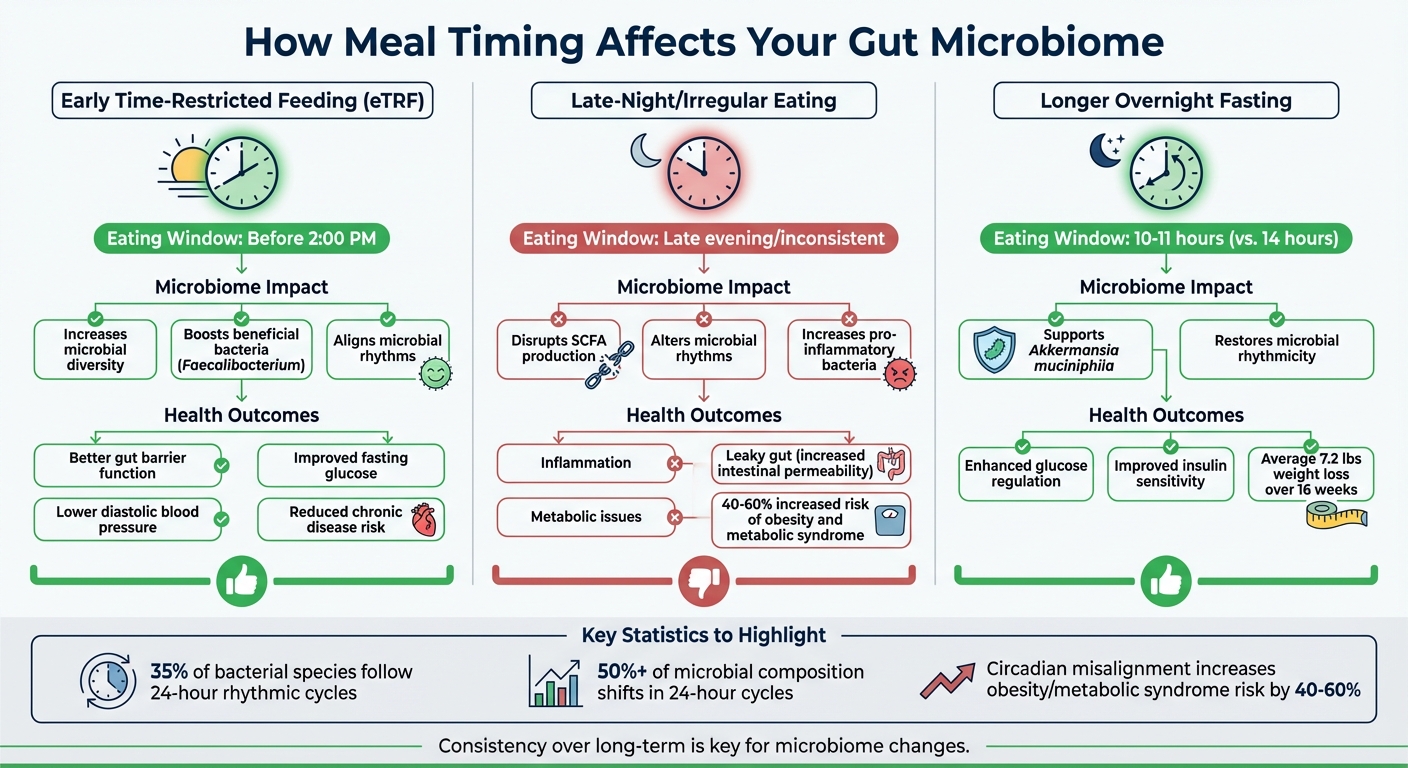
Meal Timing Approaches and Their Impact on Gut Microbiome Health
You can improve your digestive health by incorporating early time-restricted feeding (eTRF) into your daily routine. This approach focuses on eating most of your calories earlier in the day - ideally before 2:00 PM - to align with your body's natural circadian rhythms. Research suggests that this alignment can boost microbial diversity and support metabolic health [1][4].
However, don’t expect overnight results. A study [13] noted that significant microbiome changes require consistent, long-term meal patterns. Late-night eating, on the other hand, disrupts microbial rhythms and can lead to digestive issues [9][10].
Comparing Different Meal Timing Approaches
Different eating schedules can have varying effects on your gut microbiome and overall health. Here’s a quick breakdown:
| Approach | Microbiome Impact | Health Outcomes |
|---|---|---|
| Early Time-Restricted Feeding (eTRF) | Promotes microbial diversity and aligns microbial rhythms; increases beneficial bacteria like Faecalibacterium [4][11] | Better gut barrier function, improved fasting glucose, lower diastolic blood pressure, and reduced risk of chronic diseases [4][11] |
| Late-Night/Irregular Eating | Disrupts short-chain fatty acid (SCFA) production, alters salivary microbial rhythms, and encourages pro-inflammatory bacteria [4][9][10] | Leads to inflammation, increased intestinal permeability (leaky gut), and metabolic issues [4][9] |
| Longer Overnight Fasting | Supports the natural abundance of Akkermansia muciniphila and restores microbial rhythmicity [6] | Enhances glucose regulation and insulin sensitivity [6] |
For people with irregular eating habits or shift work schedules, the risks are even higher. Circadian misalignment increases the likelihood of obesity and metabolic syndrome by 40%–60% [6]. One study found that reducing the daily eating window from 14 hours to 10–11 hours led to an average weight loss of 7.2 pounds over 16 weeks [6].
These insights underline the importance of meal timing. Let’s now look at how supplements can complement your efforts to improve gut health.
Using Supplements to Support Gut Health
Supplements can play a key role in restoring balance to your gut microbiome. For example, Begin Rebirth RE-1™ is specifically designed to enhance the benefits of disciplined meal timing. This 3-in-1 eubiotic synbiotic combines prebiotics, probiotics, and postbiotics, delivering 500 billion CFU of Human Origin Strains (HOSt™) per serving. Its advanced Lyosublime™ delivery system ensures optimal absorption without the need for refrigeration.
By combining chrononutrition with targeted supplements, you can help restore gut balance, especially if you're recovering from irregular eating patterns or shift work. Reset programs lasting 7, 28, or 84 days align with the timeframes necessary for noticeable microbiome shifts [11][13].
"Chrononutrition is a promising non-pharmacological approach to preventing metabolic dysregulation and promoting gut health." – Current Nutrition Reports [4]
Conclusion
Your gut microbiome operates on a 24-hour cycle, with roughly 35% of bacterial species following rhythmic fluctuations [1][5]. This means when you eat is just as important as what you eat. Sticking to consistent meal times - especially early time-restricted feeding - aligns your body’s internal circadian rhythms with your gut bacteria. This synchronization can improve metabolic health and strengthen the gut barrier, highlighting the powerful link between meal timing and microbial balance.
Research shows that circadian misalignment, such as that caused by shift work, increases the risk of obesity and metabolic syndrome by 40%–60% [6]. Eating late at night disrupts the production of short-chain fatty acids and weakens gut barrier integrity [4]. On the other hand, maintaining a consistent eating schedule and focusing on consuming calories earlier in the day can help restore microbial balance, even after periods of irregular eating.
"The gut microbiome is highly dynamic, exhibiting daily cyclical fluctuations in composition." – Amir Zarrinpar, MD, PhD, University of California San Diego [3]
To support these natural cycles, aim to consume most of your calories before 2:00 PM and extend your overnight fasting period to at least 12 hours. This practice gives beneficial bacteria, like Bacteroidetes, the time they need to complete their daily cycles [3][1].
Consistency over the long term is key [13]. Whether you’re recovering from irregular eating habits or looking to optimize your digestive health, pairing disciplined meal timing with targeted support can help you achieve a balanced and diverse microbiome. Aligning your eating habits with your gut’s natural rhythms is a foundational step toward better digestive health.
For an extra boost on your gut health journey, check out Begin Rebirth RE-1™, a clinically designed microbiome reset that combines prebiotics, probiotics, and postbiotics to restore balance and support your immune system.
FAQs
How does the timing of meals affect gut health and microbiome diversity?
The timing of your meals is more important than you might think when it comes to maintaining a healthy gut microbiome. Research reveals that many gut microbes operate on a 24-hour rhythm, meaning they thrive when your eating habits align with your body’s internal clock. For instance, having your larger meals earlier in the day can promote a more diverse microbial community. On the flip side, irregular eating patterns or indulging in late-night meals can throw off these rhythms, potentially reducing the beneficial bacteria in your gut.
Sticking to consistent meal times doesn’t just benefit your gut; it can also improve digestion, boost immune function, and support your overall metabolic health. For even better results, combining a regular eating schedule with targeted gut health solutions like Begin Rebirth RE-1™ can help restore balance and strengthen your digestive system.
How does eating earlier in the day benefit gut health?
Eating earlier in the day, a practice known as early time-restricted feeding (eTRF), can do wonders for gut health. By syncing meal times with the body’s natural circadian rhythm, eTRF helps maintain a balanced gut microbiome and supports smooth digestion. On the flip side, eating later in the day can disrupt the diversity of gut and oral microbes, which may negatively impact metabolism.
Studies highlight that eTRF encourages the growth of beneficial gut bacteria, particularly those that produce short-chain fatty acids - compounds associated with better metabolic health. Additionally, it aligns the gut microbiota with the body’s internal clock, reducing signs of microbial imbalance and improving overall gut performance.
For those aiming to enhance gut health while fine-tuning meal timing, Begin Rebirth RE-1™ offers a 3-in-1 eubiotic synbiotic that quickly restores microbial balance and bolsters immune health.
Can intermittent fasting benefit my gut health?
Intermittent fasting (IF), which alternates between periods of eating and fasting, can have a positive effect on gut health by influencing the makeup and activity of your microbiome. These "fast-feed" cycles encourage beneficial shifts in gut bacteria, including greater microbial diversity and changes in key groups like Bacteroidetes and Firmicutes. Such changes are often tied to better glucose metabolism, lower inflammation, and improved digestive health overall.
Research also indicates that fasting can boost the production of short-chain fatty acids, which are essential for both gut and metabolic health. Since individual reactions to IF can differ, starting with manageable fasting intervals - like 12 to 16 hours - and sticking to a fiber-rich diet can help you get the most out of it. For added gut support during fasting, Begin Rebirth RE-1™ offers a clinically tested 3-in-1 synbiotic designed to help balance your microbiome and ease digestion. As always, check with your healthcare provider before making major dietary changes.