

Probiotics often struggle to survive the harsh digestive journey, limiting their effectiveness. pH-responsive systems offer a solution by protecting probiotics during digestion and ensuring they reach the intestines intact. These systems use materials like alginate, pectin, and specialized coatings that react to pH changes, shielding probiotics in acidic environments (like the stomach) and releasing them in neutral or alkaline areas (like the intestines).
Key Takeaways:
- Why It Matters: Probiotics need to survive stomach acid to benefit gut health. Most unprotected strains lose viability quickly in acidic conditions.
- How It Works: pH-responsive systems use polymers that form protective gels in acidic stomach conditions and dissolve in the intestines.
- Recent Advances: Research shows survival rates of encapsulated probiotics can exceed 87% in acidic environments compared to less than 2% for unprotected formulations.
- Health Impact: These systems improve gut microbiome balance, support immunity, and may help manage conditions like IBS and metabolic syndrome.
pH-responsive systems are transforming how probiotics and prebiotics (synbiotics) are delivered, ensuring they work where they’re needed most: in your gut.
Recent Studies on pH-Responsive Synbiotic Delivery
Research Findings
Recent research highlights how pH-responsive systems significantly enhance probiotic survival. In October 2024, a team from Zhejiang Gongshang University, led by Dr. Yue Zhang, created "super gastro-resistant" microcapsules designed for Lactobacillus rhamnosus GG. Using a 9:1 alginate-to-pectin ratio fortified with CaCO₃ nanocrystals, their formulation achieved a viability of 10.32 Log CFU/g, with 8.49 Log CFU/g surviving the harsh conditions of gastric digestion [9].
"The formulation with CaCO₃ nanocrystals significantly improved the survival number compared to the alginate/pectin formulation. This can be attributed to the buffering properties of CaCO₃." – Dr. Yue Zhang, Zhejiang Gongshang University [9]
The CaCO₃ nanocrystals act as an antacid buffer within the microcapsules, neutralizing stomach acid and shielding the probiotics during digestion. Animal testing further showed that these encapsulated probiotics led to notable changes in gut microbiota compared to their non-encapsulated counterparts [9].
Another study conducted in 2024/2025 involved a collaboration between Ritual and ProDigest in Belgium. They tested Ritual's Synbiotic+ formulation using the Simulator of the Human Intestinal Microbial Ecosystem (SHIME®). The results confirmed that the majority of probiotics survived their journey through the stomach and small intestine, reaching the colon in a viable state, thanks to the use of nested, delayed-release capsules [5]. Earlier research from April 2016, carried out by the University of Massachusetts, explored coating alginate microgels with chitosan to encapsulate Bifidobacterium longum. The chitosan coating provided a charge of +9.9 to +14.9 mV and offered strain-specific survival benefits, particularly for B. infantis UMA 299 [10].
These studies emphasize the importance of pH-triggered polymer systems in improving the delivery and effectiveness of probiotics.
How pH-Triggers Improve Delivery
pH-responsive systems rely on polysaccharides like alginate and pectin that react dynamically to changes in pH. In the stomach's acidic environment (pH 1.0–3.0), these polymers form a compact gel that protects probiotics from stomach acid and digestive enzymes.
As the encapsulated synbiotics progress into the small intestine and colon - where the pH rises to around 6.0–7.0 - the polymers deprotonate, expand, and gradually dissolve. This process allows the probiotics to be released precisely where they can have the most impact [9][10]. Advanced formulations go a step further by incorporating CaCO₃ nanocrystals, which continuously buffer the surrounding pH, further boosting probiotic survival. These mechanisms lay the groundwork for the cutting-edge technologies and materials explored in the next section.
Technologies and Materials for Better Absorption
pH-Sensitive Polymers and Coatings
pH-responsive materials play a critical role in protecting probiotics as they travel through the digestive system. One of the most commonly used materials is alginate, a natural polysaccharide derived from brown algae. Alginate is known for its ability to resist the stomach's acidic environment (pH 2.0–2.5) by forming a gel that safeguards probiotics and releases them at the right time [1][12].
However, alginate on its own has limitations due to its porous nature, which allows acid to seep through. To address this, chitosan, a polymer extracted from crustacean shells, is often added as a secondary coating. This combination forms a polyelectrolyte complex (PEC) that significantly reduces porosity. Research has shown that chitosan-coated alginate can keep Bifidobacterium bifidum viable at levels above 1,000,000 CFU/mL after 2 hours in a highly acidic environment (pH 2), whereas unprotected cells experience a significant drop to less than 1.87 log units [12].
Another material, Eudragit S100, is designed for targeted delivery to the colon. This synthetic polymer remains intact until it encounters a pH level above 7.0, ensuring that probiotics bypass both the stomach and the small intestine [4]. Similarly, pectin withstands gastric acid but breaks down in the colon, while cellulose acetate phthalate dissolves only in the small intestine [8][12].
These advanced coatings provide a foundation for microencapsulation techniques, which take probiotic protection and delivery to the next level.
Microencapsulation Methods
Microencapsulation builds on these materials by creating an additional physical barrier that shields probiotics from stomach acid and bile salts while enabling their controlled release in the intestines. A popular approach involves using multi-layer coatings, such as an alginate core surrounded by a chitosan shell. This design reduces porosity and prevents premature release in the upper digestive tract [2][13].
Some cutting-edge techniques also integrate prebiotics directly into the capsule matrix. For instance, in March 2023, researchers at Al-Farabi Kazakh National University developed hybrid symbiotic beads using a 1:1 mix of alginate and pullulan (a prebiotic), coated with a 0.5% bacterial cellulose solution. These beads maintained a bacterial titer of 1,000,000,000 CFU/g and were engineered for digestion by intestinal enzymes, ensuring the probiotics are released in the colon. The prebiotic not only nourishes the probiotics but also strengthens the polymer’s hydrogen network, boosting the capsule’s mechanical durability [13].
Another innovative system, the EDTA-Ca-Alginate system, offers a dynamic solution. This system remains in liquid form at neutral pH but transforms into a protective hydrogel in acidic conditions (pH below 4.0). Researcher Weiting Yu explained:
"In an acidic environment, the hydrogel structure remained compact with negligible pores to protect L. rhamnosus... in a neutral intestinal environment, the hydrogel structure gradually disassembled" [1].
This approach effectively balances the need for stability in the stomach with controlled release in the intestines, addressing a long-standing challenge in probiotic delivery.
Clinical Results and Health Benefits
Restoring Microbiome Balance
Research highlights how pH-responsive systems can help restore gut microbiome balance. For instance, a 2021 study by Phavichitr et al. examined the effects of a synbiotic mixture containing Bifidobacterium breve M-16V combined with a GOS/FOS blend (in a 9:1 ratio) on infants. The findings revealed a significant decrease in C. difficile levels and an increase in infant-type microbiota, enriched with Bifidobacterium species. This resulted in a gut profile resembling that of breast-fed infants [7].
These systems ensure that beneficial bacteria survive the digestive process and reach the colon, where they work to rebalance microbial populations. This includes adjusting the Firmicutes-to-Bacteroidetes ratio and inhibiting harmful pathogens like E. coli, Klebsiella, and C. difficile. Additionally, they promote the production of short-chain fatty acids (SCFAs), B-group vitamins, and vitamin K, which together support the gut mucosal barrier and enhance digestive health [7]. This microbial rebalancing also contributes to better immune system performance.
Immune Function and Other Health Effects
Beyond supporting gut health, pH-responsive systems have been shown to improve immune function. Clinical trials provide evidence of these immune benefits. A 2021 randomized controlled trial by Neyrinck et al. found that middle-aged participants who consumed a synbiotic containing Bifidobacterium animalis subsp. lactis and fructo-oligosaccharides (FOS) for 30 days experienced reduced levels of pro-inflammatory cytokines, including IL-6, IL-8, IL-17a, and INF-γ [7].
Another study spanning 10 weeks focused on obese individuals with metabolic syndrome. Participants consumed yogurt fortified with Streptococcus thermophilus, Lactobacillus delbrueckii subsp. bulgaricus, and Bifidobacterium animalis subsp. lactis BB-12, enriched with inulin and whey protein. The results showed reductions in body fat mass, improved insulin sensitivity, and decreased blood pressure [7].
The immune benefits are linked to stimulated colonic B lymphocytes, which produce IgA antibodies. These antibodies help block pathogen adhesion and neutralize toxins [14]. Importantly, pH-responsive systems maintain probiotic viability at levels of 6–8 Log CFU/mL throughout digestion, ensuring that enough live bacteria reach the colon to deliver their therapeutic effects [2][6].
sbb-itb-1bbfe7f
pH-Responsive vs. Standard Delivery Systems
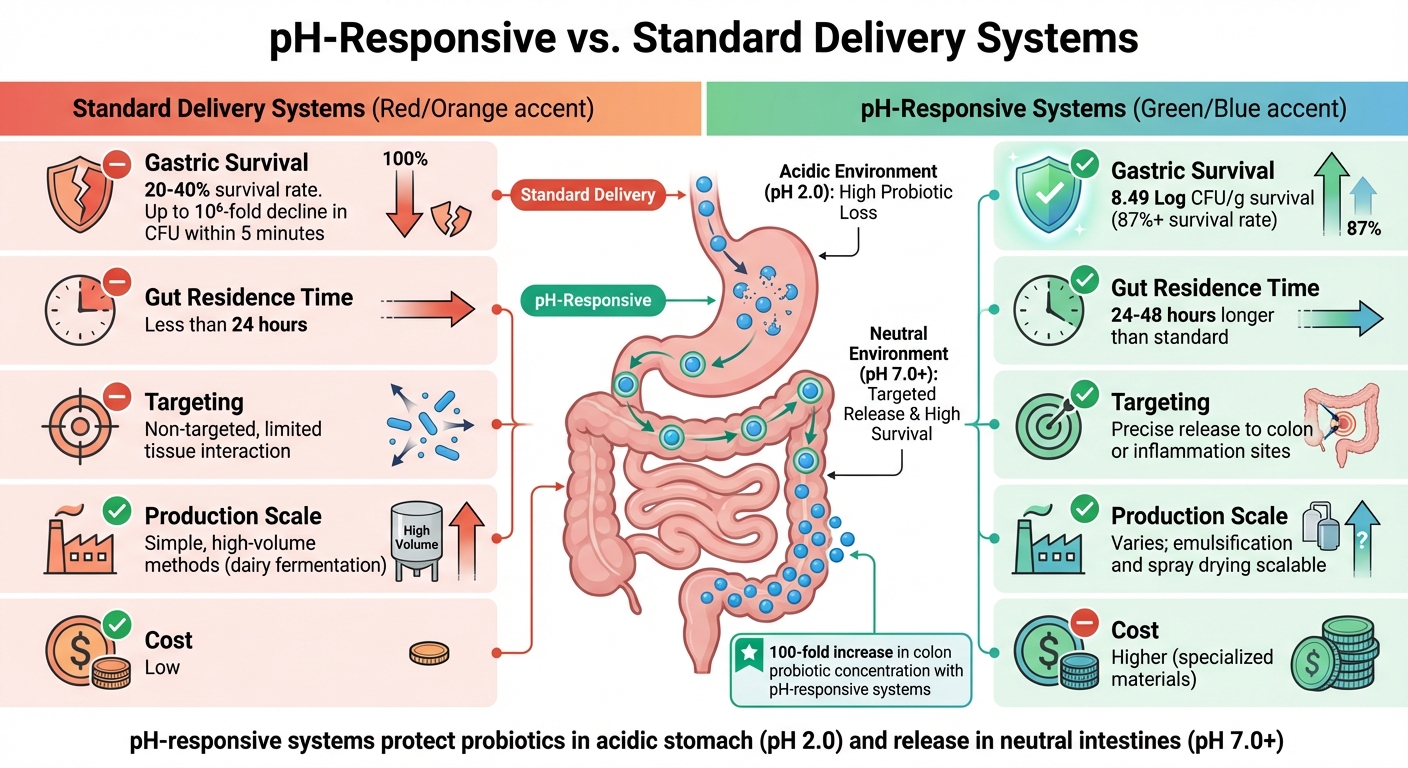
pH-Responsive vs Standard Probiotic Delivery Systems Performance Comparison
When comparing pH-responsive systems to standard delivery methods, the advantages of the former become clear, especially in terms of survival rates and targeted release.
Standard delivery methods, like fermented milk or non-encapsulated probiotics, expose beneficial bacteria to the harsh environment of stomach acid and bile salts almost immediately. This exposure leads to significant degradation. As A. Bezkorovainy from Rush Medical College explains, "Survival rates have been estimated at 20–40% for selected strains, the main obstacles to survival being gastric acidity and the action of bile salts" [11]. In fact, non-encapsulated probiotics can suffer a staggering 10^6-fold drop in colony-forming units (CFU) within just five minutes under simulated gastric conditions [17].
On the other hand, pH-responsive systems take a more strategic approach. These systems use specialized polymers like Eudragit S100 or alginate/pectin composites that remain stable in the stomach's acidic environment (pH 2.0) but dissolve or open pores in the neutral pH of the intestines (pH 7.0+) [9][15]. This approach shields probiotics from harmful gastric acid, bile salts, and oxygen exposure. For instance, an October 2024 study showed that encapsulating Lactobacillus rhamnosus GG using High-Efficiency Vibration Technology in alginate/pectin beads boosted survival to 8.49 Log CFU/g [9].
The benefits don't stop there. pH-responsive microparticles have demonstrated over 15 times greater protection for sensitive ingredients compared to standard commercial formulations [15]. Additionally, a May 2024 study in Nature Communications highlighted a breakthrough with Saccharomyces boulardii. Researchers engineered a targeted surface display for this probiotic, resulting in a 100-fold increase in probiotic concentrations in the colon and extending gut residence time by 24–48 hours compared to non-targeted strains [16].
Performance Comparison Table
Here’s how the two systems stack up:
| Feature | Standard Delivery | pH-Responsive Systems |
|---|---|---|
| Gastric Survival | Low (20–40% survival; up to 10^6-fold decline) [11][17] | High (8.49 Log CFU/g survival) [9] |
| Gut Residence Time | Short (<24 hours) [16] | Extended (24–48 hours longer) [16] |
| Absorption/Targeting | Non-targeted; limited tissue interaction [16] | Precise release to colon or inflammation sites [9][16] |
| Production Scale | Simple, high-volume methods (e.g., dairy fermentation) | Varies; emulsification and spray drying are easier to scale than freeze-drying [17] |
| Cost | Low | Higher due to specialized materials and processes [17] |
The evidence strongly supports the benefits of pH-responsive systems. By protecting probiotics during their journey through the stomach and ensuring targeted release, these systems maximize the effectiveness of probiotics in restoring microbiome balance.
That said, these advanced systems come with trade-offs. Standard spray drying is cost-effective and energy-efficient, while freeze-drying - though widely used for probiotics - demands significant energy and time [17]. pH-responsive systems, while more expensive due to the use of specialized polymers, offer innovations like solvent-free loading and faster fabrication times with pored microparticles, which could help reduce operational costs [15]. For those prioritizing probiotic viability and effectiveness, the investment in pH-responsive systems is well worth it.
Conclusion
Recent research highlights how pH-responsive systems are reshaping synbiotic delivery by tackling a key challenge: ensuring probiotics survive the harsh environment of the digestive tract and reach the intestines in sufficient numbers to be effective.
These systems take advantage of the natural pH variations in the gastrointestinal tract. For example, materials like EDTA-Ca-alginate stay intact in the stomach's acidic conditions but break down in the more neutral or alkaline environment of the intestines. This design solves the dual challenge of protecting probiotics from stomach acid while ensuring their release where they’re needed most - inside the intestines[1][2].
Beyond protection, pH-responsive systems also allow for the co-delivery of probiotics and prebiotics. This ensures that probiotics not only survive the journey but also have immediate access to their nutrient source upon reaching the colon, which houses between 10¹¹ and 10¹² bacteria per gram. Studies show that alginate microcapsules effectively shield both components during digestion, delivering them to the colon intact, where colonization can begin right away[2][14].
These systems help probiotics achieve the critical concentration of at least 10⁶ CFU/g, a threshold necessary for measurable health benefits. Clinical trials suggest their potential in managing conditions like inflammatory bowel disease, irritable bowel syndrome, and infectious diarrhea[2][3][6]. The success of these systems is paving the way for new products and broader applications in gut health.
With the global synbiotic market expected to hit $1.8 billion by 2026, growing at 8.9% annually[6], pH-responsive delivery is driving a shift in how gut health supplements are developed. Products like Begin Rebirth RE-1™ (https://beginrebirth.com) demonstrate how this innovative approach is turning synbiotics into dependable tools for restoring microbiome balance.
FAQs
How do pH-responsive systems enhance probiotic survival and absorption in the digestive system?
pH-responsive delivery systems are crafted to safeguard probiotics as they journey through the stomach's acidic environment, where pH levels hover around 2–3. Once they reach the more neutral conditions of the small intestine (pH 6.5–7.5), these systems release the probiotics, ensuring they stay active and make it to the gut, where they can deliver their full range of benefits.
These systems often rely on materials like alginate beads or calcium-EDTA complexes. These materials create a protective barrier in the stomach's low pH but dissolve or become porous in higher pH environments. This design shields probiotics from the stomach's acid and bile salts, enabling them to survive the harsh conditions and establish themselves in the gut. Research has shown that such systems significantly boost the survival rate and overall effectiveness of probiotics.
Begin Rebirth RE-1™ uses the Lyosublime™ delivery system, a pH-responsive technology that protects its potent 500 billion CFU synbiotic blend during its passage through the stomach. This system ensures the probiotics are released precisely in the colon, promoting efficient absorption and supporting a rapid reset of the microbiome.
What materials are used in pH-responsive systems to enhance synbiotic delivery?
pH-responsive delivery systems for synbiotics often rely on natural materials like calcium-alginate, which can form gels or beads that respond to varying pH levels throughout the digestive tract. To enhance their performance, pectin is frequently added to boost acid resistance and mechanical strength, while starch is used to create capsules that remain stable in the stomach but release their contents in the colon.
Other materials, such as arabinoxylan, are also utilized. When combined with alginate, arabinoxylan improves controlled release. Similarly, EDTA-Ca-alginate is designed to dissolve quickly in the intestines. For more advanced applications, smart hydrogels or nanostructured polymers - like hyaluronic acid derivatives - are incorporated to precisely control the release of probiotics. Together, these materials protect probiotics during their journey through the stomach and ensure their release in the colon, optimizing absorption and promoting gut health.
What are the health benefits of pH-responsive synbiotic systems?
pH-responsive synbiotic systems are crafted to shield probiotics and prebiotics as they navigate through the stomach's acidic environment, ensuring their release in the small intestine and colon - areas with a more favorable pH. This precise delivery method allows a greater number of live probiotics to reach the gut, where they can actively contribute to gut health.
These systems play a key role in boosting probiotic survival, improving nutrient absorption, and maintaining a balanced gut microbiota. Potential benefits include alleviating issues like irritable bowel syndrome, inflammatory bowel disease, and gut infections. They may also bolster immune function and reduce gut inflammation. The prebiotic components further enhance digestive health by encouraging the production of short-chain fatty acids, which help fortify the gut barrier.
A standout example of this innovation is Begin Rebirth RE-1™, featuring the Lyosublime™ delivery system. This technology ensures precise pH-triggered release. Each serving provides an impressive 500 billion CFU of human-origin probiotics, along with prebiotics and postbiotics, promoting a rapid microbiome reset and supporting sustained gut health and immune strength.