

Keeping probiotics effective is challenging, but double emulsion technology offers a solution. This method creates a protective barrier around probiotics, improving their survival during storage, manufacturing, and digestion. Here's what you need to know:
- Probiotics need protection: Heat, oxygen, and stomach acids often destroy probiotics before they can deliver health benefits.
- How double emulsions work: They use a water-in-oil-in-water structure (W1/O/W2) to shield probiotics from harsh conditions.
- Key benefits: Studies show double emulsions can maintain over 80% probiotic survival during digestion and ensure stability for up to 120 days in storage.
- Materials used: Polyglycerol polyricinoleate (PGPR), plant proteins, and stabilizers like sodium alginate help create these protective layers.
- Real-world results: Encapsulation efficiency exceeds 96%, and survival rates during digestion are significantly higher compared to non-encapsulated probiotics.
Double emulsions are a reliable method for preserving probiotics in food products, ensuring they remain viable and effective when consumed. This technique is paving the way for better gut health solutions.
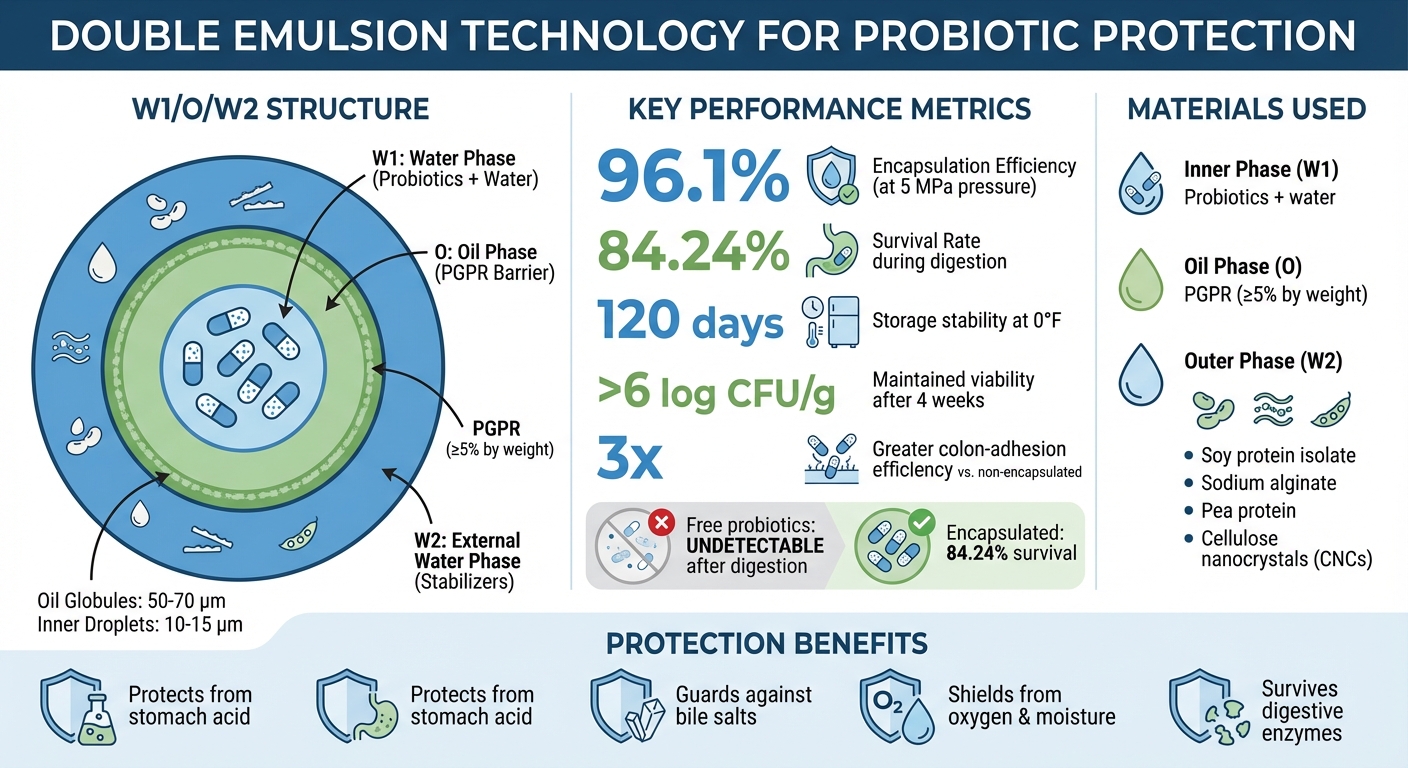
How Double Emulsion Technology Protects Probiotics: W1/O/W2 Structure and Benefits
What Is Double Emulsion Technology?
The Structure of Double Emulsions
Double emulsion technology uses a layered structure to provide probiotics with enhanced protection. In a typical W1/O/W2 system, probiotics are suspended in an internal water-based phase (W1), which is then emulsified into an oil phase (O). This initial mixture is further emulsified into an external water-based phase (W2), creating a water-in-oil-in-water structure [5][7].
Here’s how it works: the probiotics are first mixed into the inner aqueous phase (W1). This phase is then dispersed into tiny oil droplets, forming a hydrophobic layer that shields the probiotics. These oil droplets are subsequently encapsulated within a larger water phase, completing the W1/O/W2 system [5][7].
The process involves two main steps. First, the probiotics are combined with the internal water phase and an oil phase containing a lipophilic emulsifier like PGPR (polyglycerol polyricinoleate). Next, this mixture is gently emulsified with the external aqueous phase, which contains hydrophilic stabilizers such as soy protein or sodium alginate [5][7]. Studies suggest that using a lower homogenization pressure of 5 MPa results in an encapsulation efficiency of 96.1 ± 1.8%, compared to 87.3 ± 2.3% at 20 MPa [7].
"W1/O/W2 emulsions are particularly suitable for encapsulating hydrophilic bioactive substances (like probiotics) because they can be incorporated within the internal aqueous phase and thereby protect from the external environment." - Zhaowei Jiang, Researcher [5]
This layered structure is not just about organization - it’s designed to provide robust protection for probiotics.
Protection Benefits for Probiotics
The double emulsion’s unique design offers probiotics a strong defense against external threats.
The dual-layer structure offers clear advantages over traditional methods. The oil layer acts as a semi-permeable shield, protecting probiotics from oxygen, moisture, and harsh conditions during storage and digestion [5][2].
In the digestive system, this oil layer plays a crucial role. It helps guard probiotics against stomach acids, bile salts, and digestive enzymes. For instance, a 2023 study found that encapsulating Lactobacillus acidophilus in a double emulsion achieved over 96% encapsulation efficiency, maintaining high survival rates during simulated digestion [5]. In another study, free Lactobacillus acidophilus didn’t survive sequential gastric and intestinal digestion, while those encapsulated in a Pickering double emulsion showed an 84.24% survival rate [2].
Double emulsion technology has also shown promise in fermented products. A 2018 study used W1/O/W2 emulsions to deliver Lactobacillus paracasei in set-type yogurt. The probiotics stayed encapsulated in the internal phase for 28 days at 39°F, preventing interference with yogurt starter cultures during fermentation [2]. Unlike spray drying or freeze drying, which expose probiotics to extreme heat and mechanical stress, the gentle processing conditions of double emulsions help preserve a higher percentage of viable bacteria [5].
Materials That Make Double Emulsions Work
Emulsifiers and Stabilizers Used
To achieve the layered structure needed for double emulsions, the choice of materials in each phase is crucial. The success of double emulsions hinges on selecting the right components. For stabilizing the internal water-in-oil interface, Polyglycerol polyricinoleate (PGPR) is a standout option. This food-grade lipophilic surfactant is highly effective, and using at least 5% PGPR by weight is essential to create a robust primary emulsion capable of surviving further processing steps [5][7].
In the external water phase, plant proteins prove to be excellent hydrophilic emulsifiers. Pea protein and soy protein isolate work particularly well, especially when combined with polysaccharides. A study published in Food Chemistry in August 2023 highlighted the effectiveness of pairing soy protein isolate with sodium alginate. This combination achieved an encapsulation efficiency of over 96% for L. acidophilus [5]. Sodium alginate not only increased viscosity and stability but also improved the probiotics' ability to adhere to intestinal walls.
"Sodium alginate increased the viscosity, stability, and probiotic encapsulation efficiency of the double emulsions, which was mainly attributed to its interactions with adsorbed soy proteins." - Food Chemistry [5]
Cellulose nanocrystals (CNCs) also play an important role as stabilizers. In February 2025, researchers at the University of Georgia tested various formulations of pea protein and CNCs for encapsulating Lactobacillus rhamnosus GG. The results showed that CNCs significantly reduced particle size and enhanced stability, with zeta potential values dropping below -30 mV - an indicator of a stable emulsion [8]. The CNCs prevent protein aggregation through hydrogen bonding and van der Waals forces, ensuring a more uniform system.
Prebiotics like inulin can also be integrated into the wall material. For instance, a study from August 2020 published in LWT - Food Science and Technology used a mix of gum arabic and sodium alginate with inulin in the external phase. This setup maintained probiotic viability above 6 log CFU/g for four weeks at -0.4°F and achieved an 86.1% survival rate during simulated digestion [1].
These material choices demonstrate how specific ingredients and their interactions drive the performance of double emulsions.
How Component Ratios Affect Performance
Once the right materials are selected, the ratios in which they're used play a key role in enhancing stability. Proper balance between components strengthens the protective layers of the emulsion. Processing conditions, such as homogenization pressure, are equally important. In May 2022, researchers at the University of Seville explored different homogenization pressures. They found that 5 MPa was ideal for maintaining high encapsulation efficiency, while higher pressures caused internal droplets to break apart [7].
The balance within protein-polysaccharide systems is another critical factor. In the University of Georgia study, pea protein and CNCs were tested at a total concentration of 15% by weight. Increasing CNC content up to 20% of the wall material improved stability and reduced droplet size. However, exceeding this threshold led to gelation in the external phase, which is undesirable [8]. Encapsulation efficiency ranged from 63% to 68%, highlighting that the stability of the primary emulsion is more impactful than the exact proportions of the outer wall.
Matching the viscosity of the primary emulsion and the external phase is equally vital. A 1:1 viscosity ratio - achieved using thickeners like xanthan gum or sodium alginate - prevents phase separation and slows the diffusion of gastric fluids during digestion [9]. This balance ensures the emulsion remains intact under physiological conditions, further enhancing its functionality.
Research on Probiotic Survival Rates
Simulated Digestion Test Results
Simulated digestion tests are used to determine how well probiotics can survive the tough conditions of the gastrointestinal tract. Recent findings highlight the effectiveness of double emulsions in protecting probiotics from degradation during digestion.
In August 2023, a research team led by Zhaowei Jiang at Northwest A&F University tested a W1/O/W2 emulsion system on Lactobacillus acidophilus. Their results showed that encapsulated probiotics achieved an impressive 84.24% survival rate after passing through both gastric and intestinal digestion stages. In stark contrast, free probiotic cells were no longer detectable after the same process [5].
Another notable study, conducted in August 2020 by Georgia Frakolaki and her team at the National Technical University of Athens, focused on Bifidobacterium lactis (BB-12). They developed a bead-in-emulsion system by combining double emulsion with extrusion. This system preserved probiotic counts above 6 log CFU/g, achieving a 98.5% survival rate across a range of pH levels and an 86.1% survival rate during a complete gastrointestinal simulation [1]. For comparison, conventional extrusion beads showed a survival rate of only 46.8% after 15 days, while the double emulsion system maintained over 82% viability even after 28 days of storage at 39°F [1].
Additionally, a gel-bead bound emulsion system tested on Lactobacillus rhamnosus 76 demonstrated a survival rate of 90.69% in simulated gastrointestinal conditions [5].
These findings underline the potential of double emulsions for enhancing probiotic stability and survival during digestion.
Measuring Stability and Protection
To further validate the protective capabilities of double emulsions, researchers rely on specific metrics like ζ-potential and particle size. These measurements provide deeper insights into how these systems shield probiotics.
The ζ-potential, which measures the surface charge of emulsion droplets, is a key indicator of stability. Higher absolute ζ-potential values increase electrostatic repulsion between droplets, reducing the risk of aggregation. For emulsions made with gum arabic and sodium alginate, typical ζ-potential values hover around -18.8 mV [1]. This negative charge helps maintain the structural integrity of the emulsion during storage and digestion.
Particle size is another critical factor. Effective double emulsions typically feature oil globules ranging from 50 to 70 μm, with internal water droplets sized between 10 and 15 μm [2]. This size range is ideal for encapsulating bacterial cells without compromising the texture of products like yogurt or dietary supplements.
Storage tests further confirm the durability of double emulsions. Probiotics encapsulated in these systems maintain viability above 6 log CFU/g for at least four weeks at 39°F. Some formulations even retain up to 7.31 log CFU/g when stored at -0.4°F for 120 days [1] [3]. This durability is attributed to the combined protective effects of the oil barrier and biopolymer shell, which shield probiotics from environmental stressors like temperature changes, moisture, and oxidation.
| Metric | Double Emulsion (W1/O/W2) | Free Probiotic Cells |
|---|---|---|
| GI Survival Rate | 84.24% – 90.69% [2] [5] | Undetectable [2] |
| Encapsulation Efficiency | >96% [5] | N/A |
| Storage Stability (39°F) | >82% viable after 4 weeks [1] | Significant loss within days |
| Inner Droplet Size | 10–15 μm [2] | N/A |
| Oil Globule Size | 50–70 μm [2] | N/A |
sbb-itb-1bbfe7f
Using Double Emulsions in Probiotic Products
Manufacturing at Commercial Scale
Producing double emulsions on a commercial scale comes with its fair share of challenges, particularly in achieving uniform droplet sizes and selecting suitable ingredients. The process involves a two-step homogenization technique: first, probiotics are dispersed in water and combined with an oil phase (W1/O). This mixture is then emulsified with a stabilizer-containing water phase to form the final W1/O/W2 system [5]. While the concept is straightforward, scaling it up is far from simple.
As Gerald Muschiolik and Eric Dickinson explained:
"Two outstanding issues are currently preventing full realization of the potential of DEs [double emulsions] in food applications: (i) the lack of availability of large-scale production equipment to ensure efficient nondestructive 2nd-stage emulsification, and (ii) the limited range of food-grade ingredients available to successfully replace polyglycerol polyricinoleate as the primary emulsifier" [6].
These hurdles require manufacturers to carefully manage processing conditions. Achieving consistent particle sizes while preserving probiotic viability is a delicate balancing act. For instance, controlling homogenization pressure and limiting the process to 2–3 passes can yield optimal results. Research shows that processing at 5 MPa maintains encapsulation efficiency above 96%, whereas increasing the pressure to 20 MPa reduces efficiency to around 87.3% [7].
To handle larger production volumes, manufacturers can adapt laboratory techniques using multiple-nozzle systems, spinning disc atomizers, or jet-cutter methods [1]. Additionally, advanced technologies like membrane emulsification and microfluidic devices offer precise control over droplet size while operating under gentler conditions that help preserve probiotic viability [4]. These approaches are particularly useful for creating formulations tailored to specific food applications, setting the stage for advanced delivery systems.
Combining with Lyosublime™ Delivery Systems
Once reliable manufacturing methods are in place, combining double emulsion technology with Lyosublime™ freeze-drying creates a powerful system for overcoming production and storage challenges. Double emulsions provide essential physical protection during processing and digestion, while Lyosublime™ ensures long-term stability without the need for refrigeration.
The Lyosublime™ freeze-drying process preserves the delicate emulsion structure by using mild temperatures, which is crucial for maintaining probiotic viability [4]. This is especially important for products like Begin Rebirth RE-1™, which delivers a potent 500 billion CFU per serving and requires stability throughout its shelf life.
Incorporating functional lipids, such as fish oil, into the oil phase can further enhance probiotic adhesion [5]. When paired with the 4.5g of fiber from GOS and inulin found in Begin Rebirth RE-1™, the result is a synergistic effect. The prebiotics serve as a carbon source for the probiotics, while the emulsion structure offers robust physical protection.
Georgia Frakolaki's research highlights the effectiveness of this approach:
"The innovative approach of BB-12 cells incorporation into a double W1/O/W2 emulsion prior to the extrusion process was proved to be feasible and effective for the encapsulation and protection of BB-12 cells under adverse conditions" [1].
This hybrid strategy - merging double emulsions with secondary techniques - paves the way for cutting-edge probiotic formulations. These systems are designed to maintain probiotic viability from production through digestion and into the intestinal environment, where colonization occurs.
Studies show that probiotics released from advanced double emulsion systems can achieve up to three times greater colon-adhesion efficiency compared to their non-encapsulated counterparts [2]. This enhanced adhesion leads to improved colonization and more effective microbiome restoration, supporting the goals of products tailored for 7-day, 4-week, or 12-week protocols.
WEBINAR | Microfluidic encapsulation of bacteria in emulsion droplets, by Nur Suaidah Moh, PhD
Conclusion
Double emulsion technology offers a powerful solution for protecting probiotics from the harsh conditions of stomach acid, bile salts, and processing stress. By forming a sturdy W1/O/W2 barrier, this method ensures the probiotics remain viable and effective, even under challenging conditions - a fact clearly demonstrated by performance data.
For example, quantitative studies show that while free probiotic cells are completely destroyed during digestion, double emulsion systems maintain survival rates above 80% [5]. They also preserve cell counts above 6 log CFU/g for up to 120 days when stored at 0°F (–18°C) [1][3].
When paired with the Lyosublime™ delivery system, double emulsions tackle both immediate and long-term stability challenges. This is especially critical for high-potency products like Begin Rebirth RE-1™, which delivers 500 billion CFU per serving alongside 4.5 g of prebiotic fiber. In this setup, the double emulsion safeguards the probiotics during production and digestion, while the prebiotics nourish the bacteria once they reach the colon.
Beyond protection, research highlights the added benefit of improved intestinal adhesion. Probiotics released from double emulsion systems show three times higher colon-adhesion efficiency compared to non-encapsulated cells [2]. This enhanced adhesion supports better colonization, making it a valuable tool for microbiome restoration protocols, whether they span a week or several months.
Ongoing advancements in manufacturing and ingredient refinement reinforce double emulsion technology as a key player in next-generation synbiotic formulations. Its ability to provide physical protection, controlled release, and improved colonization makes it an essential component for delivering probiotics that meet therapeutic goals effectively.
FAQs
How does double emulsion technology help protect probiotics during digestion?
Double emulsion technology (W₁/O/W₂) offers a clever way to protect probiotics by encasing them in a unique structure. The probiotics are first housed in a water core, which is then surrounded by an oil layer and finally enclosed in an outer water phase. This multi-layered design acts as a shield, guarding the probiotics against harsh conditions like stomach acid, bile salts, and digestive enzymes. As a result, their chances of surviving the digestive process are greatly improved.
To enhance this protection further, stabilizing agents such as sodium alginate or tragacanth gum are used. These agents boost the viscosity, forming a gel-like barrier that increases encapsulation efficiency to over 96%. This approach ensures that a higher number of live probiotics make it to the gut, where they can contribute to better digestion and a stronger immune system.
What ingredients are needed to create stable double emulsions for probiotics?
To craft effective double emulsions (W₁/O/W₂) for probiotics, using the right combination of food-grade ingredients is crucial. The inner water phase (W₁) houses the probiotics, which are then dispersed in an oil phase (O) made from lipids like fish oil or medium-chain triglycerides. These oils not only form the emulsion but also act as a protective barrier for probiotics during digestion.
A lipophilic emulsifier, such as soy lecithin or soy protein isolate, is used to stabilize the oil phase. For the outer water phase (W₂), hydrophilic stabilizers like sodium alginate and xanthan gum come into play. Sodium alginate increases viscosity and boosts encapsulation efficiency, while xanthan gum ensures uniform droplet size and prevents them from merging. Together, these components create a stable system that safeguards probiotics both during storage and their journey through the digestive system.
What challenges exist in scaling double emulsion technology for commercial production?
Scaling double emulsion technology from the lab to commercial production isn’t without its hurdles. A key challenge lies in keeping the emulsions stable during large-scale processing. Even slight tweaks in emulsifier levels or mixing intensity can trigger issues like coalescence, phase separation, or leakage of the inner phase. The energy input during production has to be just right - too much shear can damage the internal droplets, while too little can lead to uneven droplet sizes, which can impact the product's texture and shelf life.
Another obstacle is achieving consistent results across batches. Variables like pressure, phase ratios, and stabilizer concentrations need to be tightly controlled to ensure reliable encapsulation and maintain probiotic viability. To tackle this, advanced monitoring tools are vital. These tools can keep an eye on factors like droplet size and interfacial tension in real time, helping to spot any signs of instability before they become major problems.
Finally, equipment and cost issues pose significant barriers to scaling up. Techniques such as microfluidic emulsification provide precise control and gentle conditions that safeguard probiotics, but they come with high costs and are challenging to scale for mass production. Overcoming these limitations is critical for products like Begin Rebirth RE-1™, which depend on sophisticated encapsulation methods to ensure probiotics remain stable during storage and digestion.