

Ultra-processed foods (UPFs) are harming your gut health. They make up over half of the average American adult's diet and disrupt the gut microbiome, leading to serious health issues like inflammation, obesity, diabetes, and even cognitive decline. The good news? You can fix it by switching to whole, fiber-rich foods and using proven supplements to restore balance.
Key Takeaways:
- UPFs disrupt gut health by reducing fiber intake and introducing harmful additives like emulsifiers, artificial sweeteners, and preservatives.
- Health risks include chronic inflammation, "leaky gut", higher risks of diabetes, heart disease, and mental health issues like depression and dementia.
- Gut recovery is possible with dietary changes (Mediterranean or plant-based diets) and synbiotics that combine prebiotics, probiotics, and postbiotics.
Quick Fixes:
- Cut back on UPFs: Avoid products with additives like polysorbate 80, maltodextrin, and artificial sweeteners.
- Eat whole foods: Focus on fresh vegetables, fruits, legumes, nuts, and fermented foods like yogurt or kimchi.
- Try synbiotics: Supplements like Begin Rebirth RE-1™ can help restore gut balance quickly.
Your gut health impacts digestion, immunity, and even mental well-being. Making small changes today can lead to big improvements for your health tomorrow.
Ultraprocessed foods and the gut microbiome | Dr. Benoit Chassaing | Season 3, Ep. 4
sbb-itb-1bbfe7f
How Ultra-Processed Foods Disrupt Gut Health
How Ultra-Processed Food Additives Damage Your Gut Microbiome
Ultra-processed foods (UPFs) do more than just lack nutrients - they actively disturb the delicate balance of your gut microbiome. These foods are calorie-heavy but fall short on essential nutrients, particularly fiber, which is critical for the health of beneficial gut bacteria. To make matters worse, they often include synthetic additives that can interfere with microbial diversity, allowing harmful bacteria to thrive while beneficial strains struggle to survive.
The impact of UPFs on gut health happens in several ways. First, these foods are typically devoid of dietary fiber. This deprives fiber-dependent bacteria, such as Lachnospira and Ruminococcus species, of their primary energy source [3]. At the same time, the high levels of sugar, salt, and saturated fats in UPFs fuel pro-inflammatory microbes. A June 2024 analysis of the Obekit trial by researchers at the National Institutes of Health revealed that men consuming more than five servings of UPFs daily had lower bacterial richness compared to those eating fewer than three servings [3]. Beyond these broad disruptions, specific additives in UPFs further aggravate the imbalance in the gut microbiome.
Harmful Ingredients in Ultra-Processed Foods
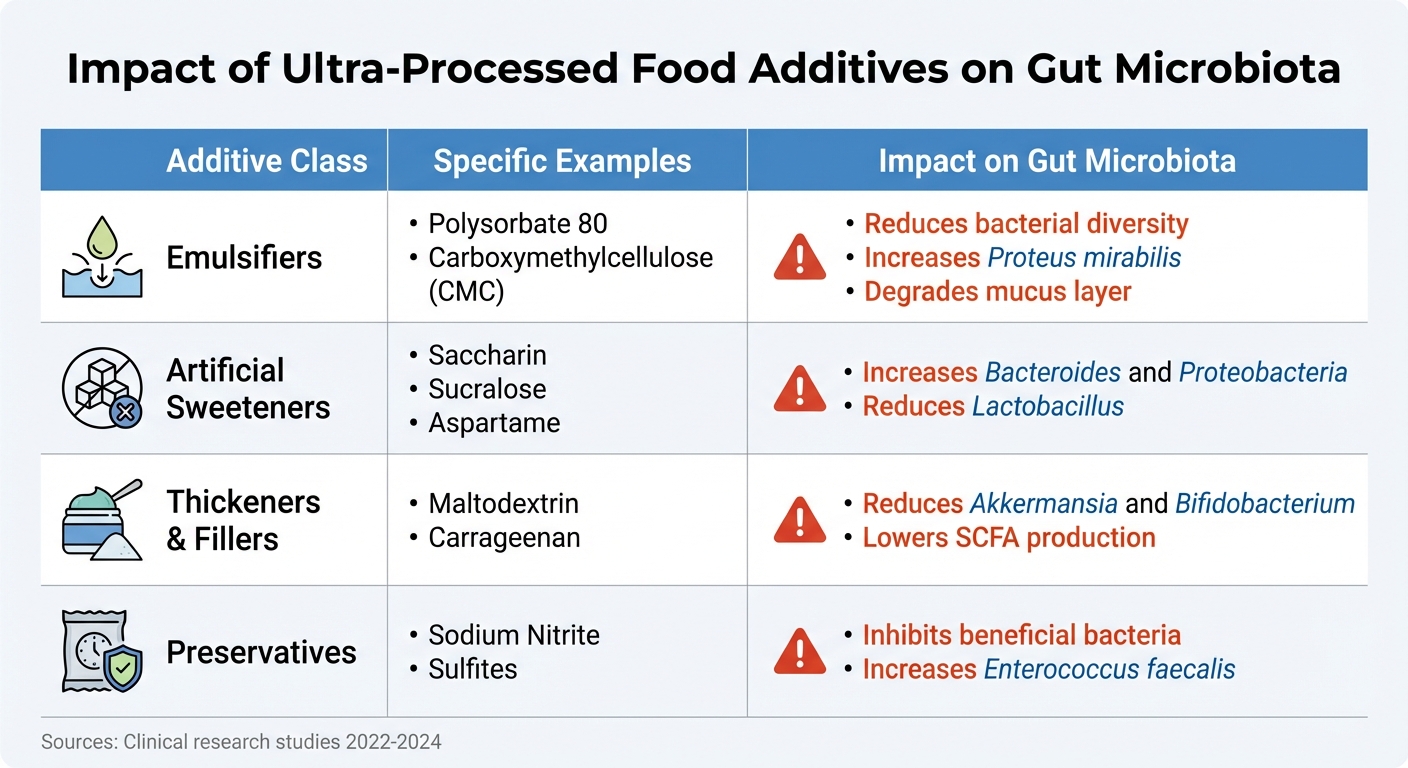
Certain additives in UPFs are particularly damaging to gut health. Emulsifiers such as carboxymethylcellulose and polysorbate 80, for example, reduce bacterial diversity and weaken the mucus barrier that protects the intestinal lining [4][1]. Dr. Michael A. Kamm from St Vincent's Hospital and the University of Melbourne explains:
"Chemical food additives interact with the gut microbiota to predispose to, contribute to the development of, or cause many of these [inflammatory and metabolic] conditions" [1].
Artificial sweeteners, including saccharin, sucralose, and aspartame, also contribute to gut imbalances by increasing pro-inflammatory bacteria like Enterobacteriaceae and Proteobacteria while reducing beneficial strains such as Lactobacillus [4][1]. Thickeners and fillers like maltodextrin and carrageenan have been linked to lower levels of protective bacteria like Akkermansia species and a reduction in short-chain fatty acids (SCFAs), which are crucial for maintaining gut barrier integrity [4]. Even preservatives can harm the microbiome; antimicrobials like sodium nitrite and sulfites inhibit beneficial bacteria, even at levels considered safe for consumption [4].
Effects on Beneficial and Harmful Bacteria
Consuming UPFs significantly alters the composition of gut bacteria. For instance, a 2022 sub-study from the PREDIMED-Plus trial, which analyzed 645 older Mediterranean adults, found that individuals consuming the most UPFs - accounting for an average of 21.4% of their daily calories - had higher levels of Alloprevotella and Negativibacillus species, both associated with inflammation [3].
Meanwhile, beneficial bacteria experience a steep decline. Research shows that UPFs reduce levels of Akkermansia muciniphila and Faecalibacterium prausnitzii, two key strains that help maintain an anti-inflammatory environment in the gut [5]. When these beneficial bacteria diminish, harmful bacteria often take their place. For example, polysorbate 80 has been shown to increase the abundance of Proteus mirabilis, a bacterium linked to Crohn's disease [1].
| Additive Class | Specific Examples | Impact on Gut Microbiota |
|---|---|---|
| Emulsifiers | Polysorbate 80, CMC | Reduces diversity; increases Proteus mirabilis; degrades mucus layer [4][1] |
| Sweeteners | Saccharin, Sucralose | Increases Bacteroides and Proteobacteria; reduces Lactobacillus [4][1] |
| Thickeners | Maltodextrin, Carrageenan | Reduces Akkermansia and Bifidobacterium; lowers SCFA production [4] |
| Preservatives | Sodium Nitrite, Sulfites | Inhibits beneficial bacteria; increases Enterococcus faecalis [4] |
These microbial shifts contribute to chronic inflammation and other health problems associated with UPF consumption.
Health Problems Linked to Gut Dysbiosis from Ultra-Processed Foods
Eating ultra-processed foods (UPFs) doesn’t just mess with your digestion - it can spark a chain reaction of health issues. The growing reliance on these foods has been linked to higher rates of chronic illnesses.
Chronic Inflammation and Disease Risk
When UPFs upset the balance of gut bacteria, they can lead to chronic inflammation, which is a key factor in many metabolic disorders. Additives like emulsifiers are known to weaken the protective lining of the gut - commonly called "leaky gut." This allows harmful bacterial components, such as lipopolysaccharides (LPS), to enter the bloodstream. Once there, these components trigger a condition called metabolic endotoxemia, which can lead to widespread inflammation and increase the risk of insulin resistance and type 2 diabetes [7][5].
Emulsifiers make matters worse by further compromising the gut barrier, paving the way for LPS to wreak havoc. This not only fuels inflammation but also raises the chances of obesity, cardiovascular problems, and high blood pressure [7][5][6][2]. Marit K Zinöcker, a researcher at Bjørknes University College, puts it this way:
"Diet-induced inflammation-related processes could interfere with our biologically fine-tuned systems for nutrient sensing and energy balance and cause food cravings and hyperphagia" [7].
On top of that, there’s a decline in helpful gut bacteria like Akkermansia muciniphila and Faecalibacterium prausnitzii, while pro-inflammatory microbes thrive. This shift only adds fuel to the fire, amplifying inflammation and even impacting the gut-brain connection [5].
Mental Health and the Gut-Brain Axis
The ripple effects of gut dysbiosis don’t stop at the gut - they extend to the brain via the gut-brain axis. This communication system links your digestive health to your central nervous system. Since about 95% of serotonin - a key mood-regulating neurotransmitter - is produced in the gut, disruptions caused by UPFs can interfere with mood balance and overall brain health [8].
When gut permeability increases, harmful substances like bacterial antigens and LPS can enter the bloodstream. This triggers the release of inflammatory molecules such as IL-1β, IL-6, and TNF-α, all of which have been associated with clinical depression [8][5]. On top of that, disruptions to the hypothalamic-pituitary-adrenal (HPA) axis can heighten anxiety levels [8][2].
Here’s a striking statistic: every 10% increase in UPF consumption raises the risk of dementia by 25%. On the flip side, swapping just 10% of UPFs with whole foods can lower that risk by 20% [2].
How to Restore Gut Microbiome Balance
If your gut health has been thrown off balance by ultra-processed foods, don’t worry - it’s reversible. By focusing on whole, fiber-rich foods and targeted supplements, you can gradually restore harmony in your gut. Let’s dive into how dietary changes and synbiotic approaches can help rebuild your microbiome.
Adding Gut-Friendly Foods to Your Diet
Switching to a Mediterranean or plant-based diet can significantly improve microbial diversity in your gut [3][6]. Focus on "NOVA Group 1" foods - these are unprocessed or minimally processed options like fresh vegetables, fruits, legumes, and nuts [3][6]. These foods are packed with Microbiome-Accessible Carbohydrates (MACs), which gut bacteria ferment to produce short-chain fatty acids (SCFAs). SCFAs not only support gut health but also lower the colon’s pH to an optimal range of 5.5 to 6.5, creating an environment that inhibits harmful pathogens like Salmonella and E. coli [9]. Plus, consuming 25 to 38 grams of dietary fiber daily has been linked to a 20% to 30% lower risk of type 2 diabetes [9].
Fermented foods such as yogurt, kimchi, and kefir are another great addition. They introduce beneficial microorganisms, particularly Lactobacillus and Bifidobacterium strains, which can replenish populations depleted by a diet heavy in processed foods [14]. If you’re looking for an extra boost, consider adding agave inulin to your routine. Studies show that just 5 to 7.5 grams per day can significantly increase Bifidobacterium levels in healthy adults [14].
As Qi Su and Qin Liu, experts in diet–microbiome interactions, put it:
"The gut microbiome may be able to act as a very sensitive mirror in response to human daily diet" [9].
Using Synbiotics for Rapid Gut Reset
While a healthy diet is essential for long-term gut health, synbiotics can speed up the process of restoring balance. These supplements combine prebiotics (food for good bacteria), probiotics (live beneficial bacteria), and postbiotics (beneficial microbial byproducts) to work more effectively together than individually [10][13].
The results speak for themselves. For example, a 2021 study from Seoul National University tested a synbiotic combination in a dysbiosis model. The group receiving synbiotics saw serum endotoxin levels drop to 1.24 EU/ml compared to 4.93 EU/ml in the untreated group. Additionally, colon length - a marker of gut health - was restored to 9.36 cm versus 8.03 cm in untreated subjects [12]. This highlights how synbiotics can repair the gut barrier and suppress harmful pathogens quickly.
For those seeking a rapid reset, Begin Rebirth RE-1™ offers a powerful, clinically supported synbiotic solution. Each serving delivers 500 billion CFU to outcompete harmful bacteria effectively. The formula includes HOSt™ (Human Origin Strains) for compatibility with the human gut, plus 4.5 grams of fiber from galactooligosaccharides (GOS) and inulin to nourish beneficial microbes. Its Lyosublime™ delivery system ensures optimal survival and colonization of the probiotics. Convenient sachets make it easy to use - no refrigeration needed. Available as a 7-day reset or extended 4-week and 12-week programs, this vegan, gluten-free, dairy-free, and non-GMO option is designed for both immediate and long-term gut health support.
In another study conducted between March and November 2019 at University Hospital Bonn, 97 participants took a synbiotic supplement containing 2 x 10^9 CFU of five strains plus inulin. After just 7 weeks, those who had been consuming less than 25 grams of fiber daily showed a significant increase in beneficial SCFA-producing microbes [11].
Practical Ways to Avoid Ultra-Processed Foods
Cutting back on ultra-processed foods doesn’t mean you have to completely overhaul your lifestyle. With smarter shopping habits and thoughtful meal planning, you can make meaningful adjustments. Here’s a promising fact: studies reveal that 93% of over 14,000 food items can be easily classified as either ultra-processed or not [3]. Let’s explore practical strategies to help you reduce these foods in your daily life.
How to Read Labels and Spot Harmful Additives
One of the simplest ways to identify ultra-processed foods is by examining the ingredient list. If you come across substances you’d never use in your own kitchen, that’s usually a red flag. As Carlos A Monteiro from the University of São Paulo explains:
"Avoidance of ultra-processed foods is the 'golden rule' of national dietary guidelines issued recently in Latin American countries" [15].
Look out for ingredients such as polysorbate 80, carboxymethylcellulose, and artificial sweeteners. Other common culprits include high-fructose corn syrup, hydrogenated oils, maltodextrin, monosodium glutamate (MSG), and preservatives like sodium benzoate and sodium nitrite [1][15].
If deciphering labels feels overwhelming, consider using smartphone apps like Open Food Facts. These apps let you scan barcodes to instantly check if a product is ultra-processed. With a database of over 75,000 identified ultra-processed items, it’s a handy tool to simplify your grocery shopping [15].
Planning Meals with Whole Foods
A straightforward way to minimize ultra-processed foods is by focusing on meals built around whole, unprocessed ingredients. Foods classified as NOVA Group 1 - such as fresh fruits, vegetables, legumes, nuts, seeds, and plain yogurt - are excellent choices. They naturally crowd out ultra-processed options while providing the fiber your gut needs to thrive [3][6].
Interestingly, research shows that altering your diet can transform your gut microbiome in as little as 3 to 4 days [9]. Start with simple, nutrient-packed meals like roasted vegetables, hearty bean soups, or fresh salads. Stick to cooking methods that preserve nutrients, such as steaming or boiling [9]. Incorporating fermented foods like kimchi or kefir into your meals can also help boost microbial diversity in your gut [5].
For those looking to take it a step further, structured reset programs can provide an additional boost.
Following Microbiome Reset Programs
Short-term reset programs can help restore gut health more quickly, especially when paired with synbiotics. For example, Begin Rebirth RE-1™ offers a 7-day microbiome reset that delivers 500 billion CFU per serving, using HOSt™ (Human Origin Strains) and a Lyosublime™ delivery system. This program is designed to rebalance the gut efficiently, with longer 4-week and 12-week options available.
The 7-day format aligns with research showing that the gut microbiome can reset in under 4 days, helping to ease your transition away from ultra-processed foods [9]. The sachets are also convenient and don’t require refrigeration, making them easy to integrate into your routine.
Conclusion
Marit K. Zinöcker highlights a critical issue: ultra-processed foods (UPFs) create a gut environment that supports microbes linked to inflammatory diseases [7]. These foods don’t just lack nutritional value - they actively harm your gut with additives, acellular nutrients, and by eroding the protective mucus barrier. With UPFs making up 60% of the average U.S. diet [1], it’s no surprise that chronic inflammation and metabolic disorders are on the rise.
But here’s the good news: your gut can bounce back quickly with the right changes. Research shows that swapping out processed foods for whole, fiber-rich alternatives can rapidly improve your microbiome. Even small changes make a difference - replacing just 10% of your UPF intake with unprocessed foods has been linked to a 20% lower risk of dementia [2]. Additionally, clinically-proven synbiotics like Begin Rebirth RE-1™ - which delivers 500 billion CFU per serving - can help restore beneficial bacteria lost to UPFs. These changes don’t just improve digestion; they ripple out into broader health benefits.
Your gut does more than process food - it plays a key role in immunity, mental health, and disease prevention. Dr. Michael A. Kamm underscores this:
"The gut microbiota is now regarded as central to a range of gut-related diseases... and may also play a role in many non-gut disorders" [1].
By shifting to a diet rich in whole, fiber-packed foods and incorporating synbiotic support, you can counteract the damage caused by UPFs. These steps not only lower dementia risk [2] but also strengthen immunity and support mental well-being [1].
The path to better gut health is simple: read ingredient labels, prioritize whole foods, and consider structured reset programs. Taking these steps can restore balance to your gut and enhance your overall health.
FAQs
How do ultra-processed foods impact gut health?
Ultra-processed foods (UPFs) are highly manufactured products that often lack fiber and essential nutrients but are loaded with additives like emulsifiers, artificial sweeteners, and preservatives. These foods do little to nourish beneficial gut bacteria, such as Faecalibacterium and Roseburia. These bacteria are crucial for producing short-chain fatty acids, which play a key role in maintaining gut health. Instead of supporting these helpful microbes, UPFs can actually reduce microbial diversity and promote the growth of harmful bacteria that trigger inflammation.
Some additives in UPFs, like emulsifiers and sweeteners, can harm the gut’s protective mucus layer, while preservatives may suppress the growth of beneficial microbes. This damage can weaken the intestinal barrier, making it more permeable - a condition often referred to as “leaky gut.” This increased permeability can lead to low-grade inflammation. Over time, these disruptions in the gut microbiome have been associated with health concerns like obesity, cardiovascular disease, and even changes in mood and cognitive function. In short, UPFs can throw your gut microbiome out of balance, impair its function, and contribute to a range of systemic health issues.
What are the best dietary changes to improve gut health and restore balance?
Ultra-processed foods - think packaged snacks, sugary drinks, and ready-to-eat meals - can negatively impact your gut by decreasing microbial diversity and creating imbalances in your gut flora. If you're looking to support a healthier gut microbiome, here are some dietary tweaks to consider:
- Cut back on ultra-processed foods and opt for whole, minimally processed alternatives instead.
- Boost your fiber intake to 25–30 grams daily by eating a mix of fruits, vegetables, legumes, whole grains, and nuts. A diverse range of plant-based foods is key to feeding the beneficial bacteria in your gut.
- Add fermented foods like yogurt, kefir, kimchi, and sauerkraut to your diet. These are rich in live probiotics that promote gut health.
- Focus on prebiotic-rich foods such as garlic, onions, asparagus, bananas, and chicory root. These help nourish the good bacteria already in your gut.
- Cut down on added sugars, artificial sweeteners, and food additives, which can disrupt your microbiome.
- Incorporate polyphenol-rich foods like berries, dark chocolate, and green tea, which can help support a balanced microbiome.
- Stay hydrated by drinking about 2 liters of water daily to keep digestion running smoothly and support microbial function.
If you're looking for a quicker, scientifically-backed option, Begin Rebirth RE-1™ might be worth exploring. This 3-in-1 eubiotic synbiotic combines prebiotics, probiotics, and postbiotics to help reset your microbiome in just seven days, making it a great complement to these dietary changes.
Can synbiotics help restore gut health quickly?
Synbiotics, which blend probiotics and prebiotics, are a powerful way to boost gut health quickly. Research highlights their ability to ease gastrointestinal discomfort, balance gut microbes, and reduce inflammation in a relatively short time.
The concept is simple yet effective: probiotics introduce beneficial bacteria, while prebiotics provide the nutrients these bacteria need to thrive. Together, they create the perfect conditions for your gut microbiome to reset and function at its best, making synbiotics an excellent choice for tackling imbalances like dysbiosis and improving overall digestion.