


The connection between gut health and weight management is undeniable. Your gut microbiome - home to trillions of bacteria - affects digestion, fat storage, hunger, and metabolism. Imbalances in gut bacteria, known as dysbiosis, can lead to weight gain, metabolic issues, and inflammation. Here’s how prebiotics, probiotics, and postbiotics play a role in restoring balance and improving metabolic health:
- Prebiotics: Non-digestible fibers like inulin fuel beneficial gut bacteria, promoting fullness and reducing fat production.
- Probiotics: Live microorganisms like Lactobacillus and Bifidobacterium improve gut balance, reduce inflammation, and aid weight loss.
- Postbiotics: Non-living microbial byproducts, such as SCFAs, directly enhance fat burning, insulin sensitivity, and appetite regulation.
Studies show combining these biotics can improve body composition, reduce waist circumference, and support long-term weight management. For optimal results, interventions should last 8–12 weeks and may include synbiotic solutions that combine prebiotics and probiotics. Products like Begin Rebirth RE-1™ integrate all three biotics, offering a streamlined approach to gut health and weight control.
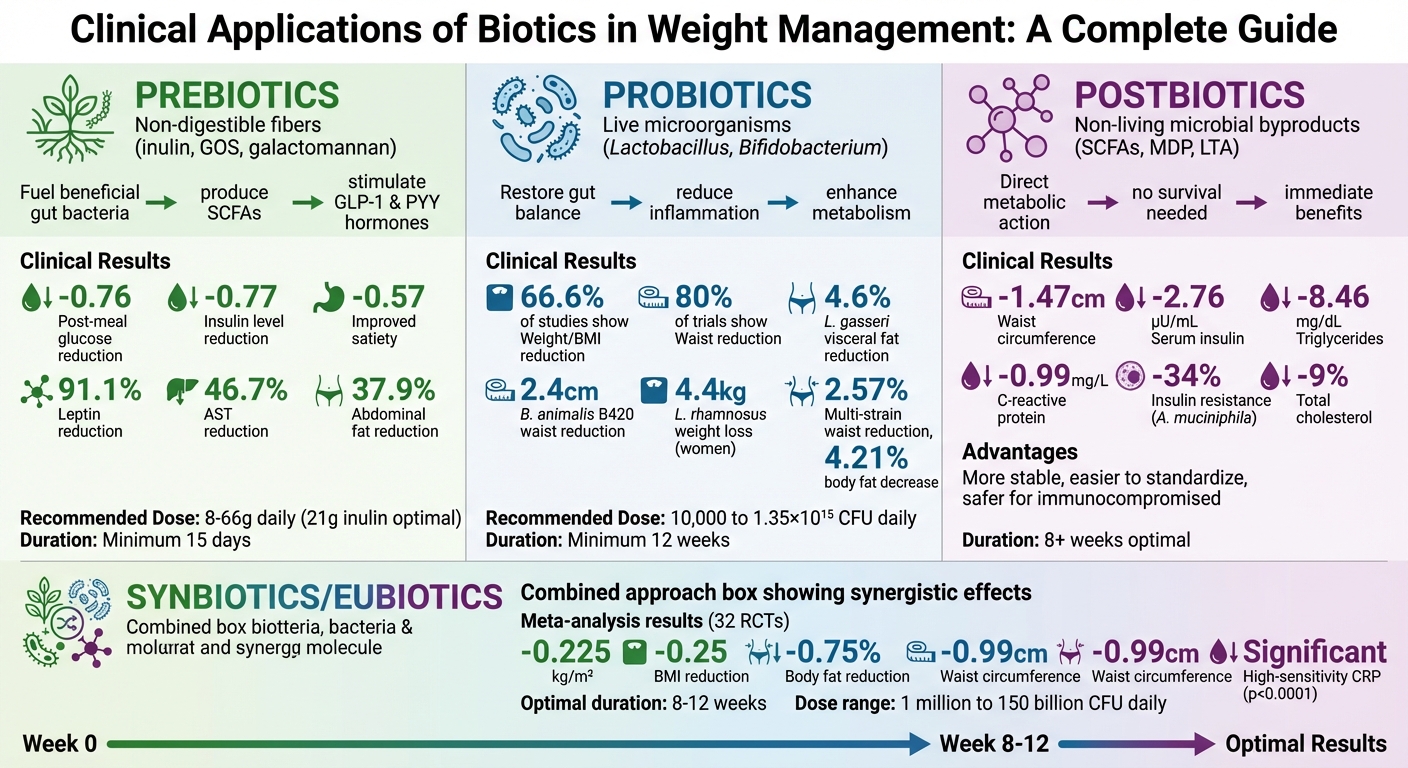
Prebiotics vs Probiotics vs Postbiotics for Weight Management: Clinical Benefits Comparison
Prebiotics for Weight Management
How Prebiotics Work in the Gut
Prebiotics play a key role in supporting gut health and, by extension, weight management. These compounds act as fuel for beneficial gut bacteria. When prebiotic fibers like inulin, galactooligosaccharides (GOS), or galactomannan are consumed, they bypass digestion in the stomach and small intestine. Instead, gut bacteria ferment these fibers, producing short-chain fatty acids (SCFAs) such as acetate, propionate, and butyrate. These SCFAs interact with intestinal receptors to stimulate the release of satiety hormones like GLP-1 and PYY, while also lowering levels of ghrelin - the hormone that triggers hunger [3][2][1].
Prebiotics also help fortify the intestinal barrier, which can prevent the leakage of inflammatory compounds often linked to obesity and insulin resistance [3][1]. Additionally, they influence fat metabolism by altering gene expression to reduce fat production [3].
With these mechanisms in mind, prebiotics emerge as a promising component of weight management strategies, complementing other approaches.
Research on Prebiotics and Weight Loss
Scientific research reinforces the role of prebiotics in weight management. Clinical studies have shown that prebiotics can produce measurable results. For example, a systematic review found that prebiotic supplementation led to reductions in post-meal glucose (-0.76) and insulin levels (-0.77), along with increased feelings of fullness (-0.57) [7].
"Dietary prebiotic consumption was found to be associated with subjective improvements in satiety and reductions in postprandial glucose and insulin concentrations." - Kellow NJ, Coughlan MT, Reid CM, British Journal of Nutrition [7]
A study conducted between 2019 and 2022 by Egypt's National Research Centre examined 58 obese women (average BMI: 38.32 kg/m²) over three months. Participants followed a hypocaloric, high-fiber diet supplemented with probiotic yogurt and regular exercise. The results were striking: serum leptin levels dropped by 91.1%, AST levels decreased by 46.7%, and abdominal skin fold thickness was reduced by 37.9%. Microbiota analysis also revealed an 8.2% increase in Lactobacillus, a 4.3% rise in Bifidobacteria, and a 3.2% decrease in the Firmicutes/Bacteroidetes ratio - changes associated with improved gut health and metabolism [6].
For prebiotics to be effective, studies suggest consuming doses between 8 and 66 grams daily for at least 15 days [3]. Specifically, 21 grams of inulin per day has been shown to increase PYY and GLP-1 levels, helping to lower energy intake and reduce body fat mass [3].
sbb-itb-1bbfe7f
Probiotics for Weight Management
Probiotic Strains That Support Weight Loss
Certain probiotic strains, particularly from the Lactobacillus and Bifidobacterium families, have been shown to help reduce body fat and waist size [4][9]. For instance, a 2010 clinical trial involving 87 overweight adults found that consuming fermented milk containing Lactobacillus gasseri SBT2055 daily for 12 weeks resulted in a 4.6% decrease in visceral fat and a 3.3% reduction in subcutaneous fat compared to a placebo group [11][13]. Similarly, Bifidobacterium animalis ssp. lactis 420 (B420) was associated with a 2.4 cm reduction in waist circumference [4].
Women may experience even greater benefits from certain strains. In a 2014 study with 125 overweight men and women, participants who took Lactobacillus rhamnosus CGMCC1.3724 over 24 weeks saw more significant weight loss. Women in the probiotic group lost an average of 4.4 kg, compared to 2.6 kg in the placebo group [9][11].
"Specific strains belonging to the genus Lactobacillus and Bifidobacterium were the most used and those that showed the best results in reducing body weight."
- Valentina Álvarez-Arraño, Department of Preventive Medicine and Public Health, University of Granada [9]
A systematic review also highlighted that using probiotics without dietary changes led to weight and BMI reductions in 66.6% of studies reviewed [4]. For the best results, probiotics should be taken daily for at least 12 weeks, allowing enough time for their effects to develop [10][9].
| Probiotic Strain | Primary Clinical Outcome |
|---|---|
| Lactobacillus gasseri SBT2055 | 4.6% reduction in visceral fat; 3.3% reduction in subcutaneous fat [11][9] |
| Bifidobacterium animalis ssp. lactis 420 (B420) | 2.4 cm reduction in waist circumference [4] |
| Lactobacillus rhamnosus CGMCC1.3724 | 4.4 kg weight loss in women (vs. 2.6 kg in placebo) [9][11] |
| Bifidobacterium breve B-3 | Reduction in body fat, waist, and hip size [11] |
| Lactobacillus sakei CJLS03 | Decrease in body fat mass and waist circumference [4][9] |
These findings highlight how probiotics not only aid in weight loss but also address underlying imbalances in gut health tied to obesity.
How Probiotics Address Dysbiosis and Obesity
In addition to supporting weight loss, probiotics help correct dysbiosis - an imbalance in gut bacteria often linked to obesity. Obese individuals tend to have lower microbial diversity and a higher Firmicutes-to-Bacteroidetes ratio, which can increase calorie absorption from food. In contrast, lean individuals typically have up to 70% more bacterial diversity in their gut microbiomes [11]. This imbalance can contribute to excessive energy extraction, making it harder to maintain a healthy weight [1][9].
Probiotics work to restore this balance by fermenting non-digestible fibers, producing short-chain fatty acids (SCFAs) that strengthen the gut barrier and reduce inflammation. These SCFAs also activate AMPK, a key enzyme that promotes fat burning and helps control inflammation [1][2][13].
Additionally, probiotics can influence appetite and metabolism. They stimulate satiety hormones like GLP-1 and PYY, which help reduce food intake [1][9]. On a cellular level, probiotics affect gene expression by enhancing fat oxidation through PPARγ and PPARα while suppressing fat synthesis via SREBP-1c. This improves both insulin sensitivity and glucose metabolism [1][3].
A recent randomized, double-blind trial conducted in May 2023 further supports these findings. Involving 63 overweight and obese participants aged 18–45, the study tested a multi-strain probiotic supplement providing 37 × 10⁹ CFU daily for 12 weeks. The treatment group experienced a 2.57% reduction in waist circumference and a 4.21% decrease in body fat percentage, while the placebo group saw a 0.92% increase in waist size [12].
For effective results, clinical doses of probiotics typically range from 10,000 to 1.35 × 10¹⁵ CFU daily [3]. Combining probiotics with prebiotic fibers like inulin or galactomannan can further enhance their benefits by boosting SCFA production through synergistic interactions [8].
Postbiotics for Weight Management
What Makes Postbiotics Different?
Unlike probiotics, which are live microorganisms, postbiotics are non-living microbial components or their byproducts that still offer health benefits [5][14]. These include short-chain fatty acids (SCFAs) like acetate, propionate, and butyrate, as well as cell wall fragments such as muramyl dipeptide (MDP) and lipoteichoic acid (LTA) [14][15].
One major perk of postbiotics is that they don’t need to survive the harsh conditions of the digestive system to be effective. Probiotics, on the other hand, must remain alive through stomach acid and bile to colonize the gut. Postbiotics, however, work right away [5][14]. This makes them more stable for storage, easier to standardize in supplements, and safer for individuals with weakened immune systems [5][14].
"Postbiotics have a higher signaling capability for different organs and tissues, improved absorption, and the ability to initiate several biological reactions that are advantageous to the user."
Postbiotics play a role in weight management through several mechanisms. SCFAs stimulate G-protein coupled receptors (GPR41 and GPR43), which help release satiety hormones [5][15]. They also activate the AMPK enzyme, which encourages fat burning and blocks fat production [14]. Additionally, postbiotics help reduce chronic inflammation by lowering markers like C-reactive protein (CRP) and Interleukin-6 (IL-6), both of which are commonly elevated in obesity [5][14].
With these unique benefits, research is increasingly focusing on how postbiotics directly influence metabolic health.
Research on Postbiotics and Weight Control
A 2025 meta-analysis of 25 randomized controlled trials found that postbiotic supplements reduced waist circumference by an average of 1.47 cm and lowered serum insulin levels by 2.76 µU/mL [5]. Triglycerides dropped by 8.46 mg/dL, and C-reactive protein levels decreased by 0.99 mg/L [5]. While overall weight loss was modest, the improvements in abdominal fat and metabolic markers were clinically meaningful [5].
In a 2019 study published in Nature Medicine, researchers tested heat-killed Akkermansia muciniphila on 32 overweight adults with insulin resistance. After 3 months of taking 10 billion cells daily, participants saw a 34% decrease in insulin resistance, a 9% drop in total cholesterol, and lost about 5 pounds compared to the placebo group [5][2]. This shows that even non-living bacteria can enhance metabolic health.
Studies suggest that longer interventions - beyond 8 weeks - yield better results for improving insulin sensitivity and other metabolic markers [5][14]. Interestingly, bacterial-based postbiotics, like heat-killed cells, appear more effective at reducing insulin levels, while SCFA-based postbiotics show stronger effects on lowering triglycerides [5]. These findings highlight the potential of postbiotics in addressing metabolic challenges tied to weight management.
Combining Prebiotics, Probiotics, and Postbiotics
How Synbiotics Work
Synbiotics bring together live probiotics and prebiotic fibers, creating a partnership that benefits the gut microbiome. Prebiotics serve as a food source, helping probiotics thrive and establish themselves in the gut. This teamwork supports gut health and can positively influence metabolic functions tied to weight management. Essentially, synbiotics amplify the individual benefits of prebiotics and probiotics.
One standout benefit is the increased production of short-chain fatty acids (SCFAs). These compounds activate receptors that stimulate satiety hormones like glucagon-like peptide 1 (GLP-1) and peptide YY (PYY). These hormones help curb appetite and slow down the digestive process, contributing to a feeling of fullness [3].
In a 12-week study involving 172 participants with BMIs ranging from 25 to 34.9 kg/m², those who received synbiotic interventions experienced significant reductions in BMI and a marked decrease in high-sensitivity C-reactive protein levels (p < 0.0001) [18].
"Correction of obesity-induced disruption of the intestinal microbiota by synbiotics may be more effective than supplementation with probiotics alone because the prebiotic components of synbiotics support the growth and survival of positive bacteria in them." - Emília Hijová, Department of Experimental Medicine, Pavol Jozef Šafárik University [17]
A meta-analysis of 32 randomized controlled trials found that synbiotic interventions led to reductions in BMI by 0.25 kg/m², total body fat by 0.75%, and waist circumference by 0.99 cm [16]. Research also suggests that daily dosages between 1 million and 150 billion CFU, taken over at least 15 days, consistently support weight management efforts [3].
Begin Rebirth RE-1™: A 3-in-1 Eubiotic Solution
Taking the concept of synbiotics a step further, Begin Rebirth RE-1™ combines prebiotics, probiotics, and postbiotics into a single, all-in-one solution. This product delivers beneficial bacteria, their nourishing fibers, and active metabolic byproducts in one convenient formulation, maximizing the benefits of biotics for weight management [17].
Each sachet contains 500 billion CFU of Human Origin Strains (HOSt™) and 4.5 g of prebiotic fiber, made from a blend of GOS and inulin. The proprietary Lyosublime™ delivery system ensures that the formulation is absorbed effectively and remains stable without refrigeration. It’s available in 7-day, 4-week, and 12-week microbiome reset programs, catering to different weight management goals.
What sets this product apart is the inclusion of postbiotics. While synbiotics work over time to reshape the gut microbiome, postbiotics offer immediate benefits by delivering SCFAs and bioactive compounds directly. These compounds support various weight management pathways, such as improving satiety, enhancing insulin sensitivity, reducing inflammation, and increasing energy expenditure [5][19]. Clinical studies show that interventions lasting over 8 weeks tend to yield the most noticeable metabolic improvements [5].
The formulation is designed to meet diverse dietary needs - it’s vegan, gluten-free, dairy-free, soy-free, nut-free, and non-GMO, making it accessible to a wide range of users.
How to Improve Gut Health for Weight Loss | Dr. Layne Norton & Dr. Andrew Huberman
Conclusion
The clinical findings discussed earlier highlight the growing body of evidence supporting the role of biotics in weight management. Studies show that probiotics can reduce body weight and BMI in 66.6% of cases and decrease waist circumference in 80% of trials - even without any dietary changes. Meanwhile, prebiotics nourish beneficial gut bacteria, leading to the production of short-chain fatty acids that trigger satiety hormones. On the other hand, postbiotics have been shown to lower serum insulin levels by 2.76 µU/mL and triglycerides by 8.46 mg/dL [4][5].
These biotic interventions address critical metabolic issues like gut dysbiosis, chronic inflammation, and disrupted energy balance - factors that traditional diet and exercise plans often fail to tackle. This makes them particularly effective for breaking through frustrating weight-loss plateaus.
Interestingly, the best results come from combining all three types of biotics. Synbiotic and eubiotic formulations, which blend probiotics, prebiotics, and postbiotics, create synergistic effects. Multi-strain combinations of Bifidobacterium and Lactobacillus consistently outperform single-strain alternatives, delivering more robust outcomes [4][9].
For meaningful improvements in BMI, waist circumference, and metabolic markers, interventions need to last at least 8 to 12 weeks. This timeframe allows the gut microbiome to stabilize and for metabolic shifts to take effect [4][5][9]. These insights form the foundation for solutions like Begin Rebirth RE-1™.
Begin Rebirth RE-1™ offers a comprehensive formulation that combines prebiotics, probiotics, and postbiotics. Each serving delivers 500 billion CFU of Human Origin Strains alongside 4.5 g of prebiotic fiber, providing a science-backed approach to restoring gut health and supporting sustainable weight management.
FAQs
What roles do prebiotics, probiotics, and postbiotics play in weight management?
Prebiotics, probiotics, and postbiotics each contribute in distinct ways to weight management and metabolic health by interacting with the gut microbiome.
- Prebiotics are types of nondigestible fibers that serve as food for beneficial gut bacteria. By encouraging a healthier balance of gut microbes, prebiotics can influence weight regulation. The effectiveness often depends on the type of fiber and the amount consumed.
- Probiotics are live microorganisms, including strains like Bifidobacterium and Lactobacillus, that support gut health. They can strengthen the gut barrier, reduce inflammation, and enhance insulin sensitivity. Research indicates they may help lower body mass index (BMI) and shrink waistlines.
- Postbiotics are bioactive substances produced by gut bacteria, such as short-chain fatty acids (SCFAs). These compounds can boost energy expenditure by promoting thermogenesis and improving fat metabolism, aiding in weight control and overall metabolic health.
A synbiotic approach - combining prebiotics, probiotics, and postbiotics - can amplify these effects. For instance, Begin Rebirth RE-1™ blends all three to reset the gut microbiome, promote metabolic balance, and support weight management, with results possible in just 7 days.
How long should biotic supplements be taken for effective weight management, and what is the recommended dosage?
For managing weight effectively, biotic supplements are usually taken in three stages: 7 days, 4 weeks, and 12 weeks. The suggested daily dose is 500 billion CFU per serving, which aids in restoring gut balance and promoting metabolic health. Be sure to stick to the recommended schedule and dosage to achieve the best outcomes.
How do synbiotics improve weight management compared to using prebiotics or probiotics alone?
Synbiotics bring together prebiotics - specialized fibers that nourish beneficial gut bacteria - and probiotics, the live bacteria that support gut health. This combination works in harmony: the prebiotics not only help probiotics survive the harsh stomach environment but also fuel their growth, while encouraging other helpful microbes in the gut. The result? A more effective reshaping of the gut microbiome compared to using prebiotics or probiotics alone.
This improved gut balance leads to an increase in short-chain fatty acids (SCFAs) like acetate, propionate, and butyrate. These compounds play a major role in weight regulation. SCFAs support appetite control by boosting satiety hormones such as GLP-1 and PYY, promote fat burning through thermogenesis, and help reduce inflammation that can contribute to insulin resistance. Clinical research has shown that synbiotics can achieve greater reductions in body mass index (BMI), waist circumference, and fat mass compared to using either prebiotics or probiotics on their own.
One example of this in action is Begin Rebirth RE-1™, a rapid microbiome reset program. It combines human-origin probiotics, targeted prebiotic fibers, and postbiotics in a high-potency formula delivering 500 billion CFU per serving. This product supports gut health, strengthens immune function, and enhances metabolic performance, offering a well-rounded approach to managing weight effectively.