

When it comes to supporting mental health, the gut-brain connection is key. Probiotics, which help balance gut bacteria, may influence mood by regulating neurotransmitters like serotonin and reducing inflammation. Here's a quick guide to picking the right probiotics:
- Focus on Specific Strains: Look for strains like Lactobacillus helveticus R0052, Bifidobacterium longum R0175, or Lactobacillus plantarum 299v, which have shown benefits for mood, stress, and anxiety in studies.
- Check CFU Count: Aim for products with 1–30 billion CFU, depending on the strain and your needs. Clinical trials often specify effective doses.
- Ensure Effective Delivery: Choose probiotics with advanced delivery systems to protect bacteria from stomach acid, ensuring they reach your gut alive.
- Consider Multi-Component Formulas: Products combining probiotics with prebiotics or postbiotics can enhance gut-brain health.
- Look for Clinical Validation: Select products backed by human studies showing improvements in mood, stress, or other mental health metrics.
Small changes, like tracking your progress and sticking to a regimen for at least 4–8 weeks, can help you see results. Always choose products with clear labeling, third-party testing, and strain-specific benefits for the best outcomes.
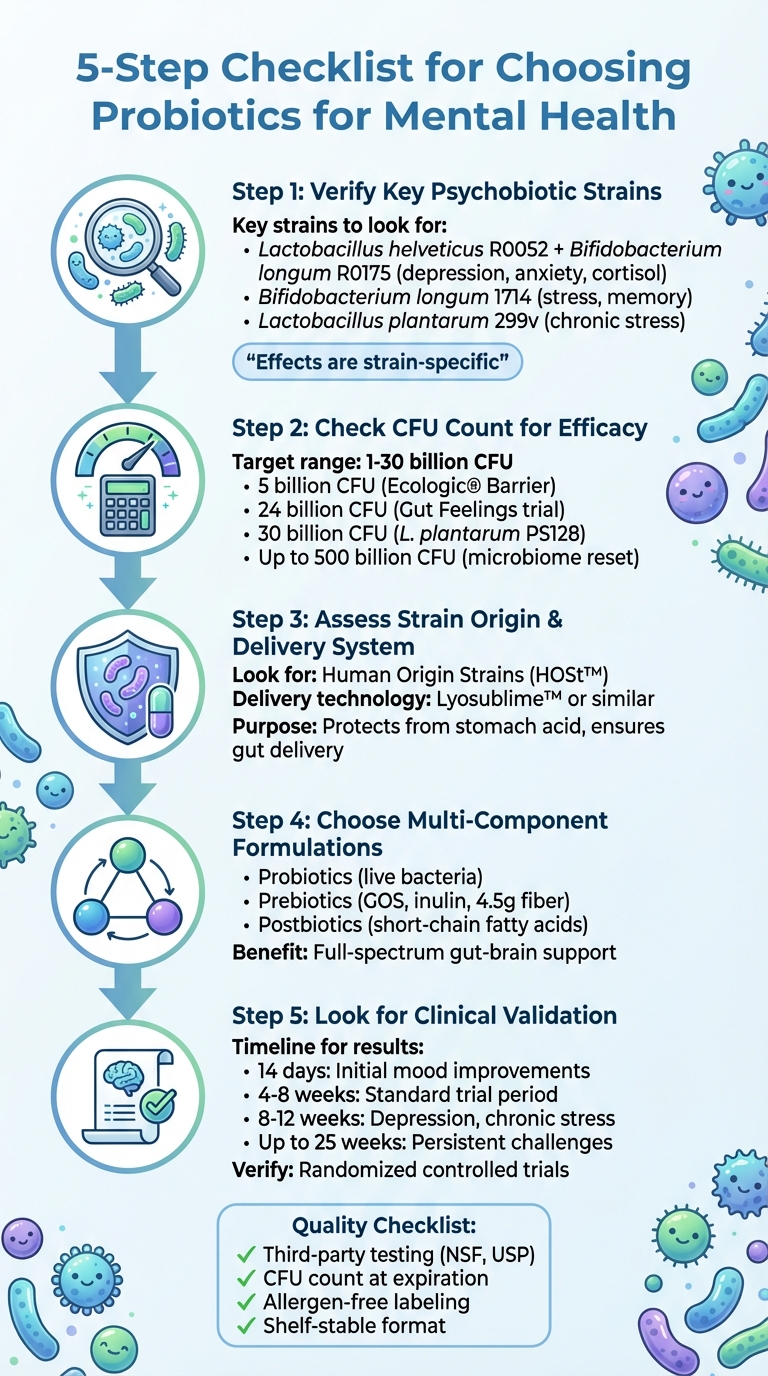
5-Step Checklist for Choosing Mental Health Probiotics
Checklist for Choosing the Right Probiotics
Step 1: Verify Key Psychobiotic Strains
Psychobiotics work on the gut–brain connection by producing neurotransmitters, short-chain fatty acids, and anti-inflammatory compounds [5]. To get the most out of probiotics, look for products that list specific strain identifiers, as their benefits are tied directly to the strain [6].
Some of the most well-researched combinations include Lactobacillus helveticus R0052 and Bifidobacterium longum R0175, which have been shown to help with depression, anxiety, and lowering urinary cortisol levels [1][6]. Other effective strains are Bifidobacterium longum 1714, known for reducing stress and improving memory, Lactobacillus paracasei Lpc-37 for managing perceived stress, and Lactobacillus plantarum 299v for reducing cortisol and mitigating chronic stress effects [4].
"The effects of probiotics are species and strain specific." - McFarland and Goh [6]
Multi-strain products can provide even greater benefits. For instance, the Ecologic® Barrier blend, which includes nine strains like B. bifidum W23 and L. acidophilus W37, showed significant mood improvements in just two weeks during a study involving 88 participants at Leiden University [3].
Once you’ve identified the right strains, confirm that the dosage matches what’s been shown to work in clinical studies.
Step 2: Check CFU Count for Efficacy
After identifying the strains, make sure the product contains the right amount of bacteria. CFU (colony-forming units) measures the number of live bacteria in each serving [7]. For mental health benefits, doses typically range from 1 to 30 billion CFU. Certain strains, like L. plantarum PS128, are formulated at 30 billion CFU for optimal results [2][6].
For example, the Ecologic® Barrier blend used 5 billion CFU daily to reduce negative moods [3]. Similarly, the "Gut Feelings" trial used 24 billion CFU per day, split into two doses of 12 billion CFU each [1]. Some products even offer up to 500 billion CFU per serving, which can help reset the microbiome quickly when paired with the right strains and delivery systems.
Step 3: Assess Strain Origin and Delivery System
Choose probiotics with Human Origin Strains, which are naturally suited to interact with the human body. Additionally, look for advanced delivery systems like Lyosublime™, which protect the probiotics from stomach acid and bile, ensuring they reach the intestines alive [4].
"The neurons present in the enteric nervous system interact directly with the neurochemicals produced by microbiota of the gut, thereby influencing the signaling to central nervous system." - Sharma et al., Current Microbiology [8]
Without proper delivery technology, even high-CFU products may lose their effectiveness before reaching the gut [4].
Once you’ve confirmed strain origin and delivery, consider formulations that combine multiple components for comprehensive support.
Step 4: Choose Multi-Component Formulations
Supporting the gut–brain axis often requires more than just probiotics. Multi-component formulations combine probiotics with prebiotics (like GOS or inulin) and postbiotics (such as short-chain fatty acids) to deliver full-spectrum benefits [1][4].
These advanced formulations not only encourage the growth of beneficial bacteria but also provide bioactive compounds that directly support gut–brain health. For example, products that include 4.5 grams of prebiotic fiber alongside high-CFU probiotics and postbiotics can significantly enhance mental well-being.
Step 5: Look for Clinical Validation
Clinical evidence is key when choosing a probiotic. Look for products supported by randomized controlled trials that show improvements in anxiety, cortisol levels, depression, or stress response.
For instance, studies often report noticeable mood improvements after two to four weeks of consistent use, with benefits typically starting around the 14-day mark [3]. With the global probiotic market projected to hit $105 billion USD by 2029 [6], it’s essential to separate science-backed products from marketing gimmicks.
A great example is Begin Rebirth RE-1™, which combines all the essential elements: Human Origin Strains (HOSt™), 500 billion CFU per serving, a 3-in-1 synbiotic formulation with 4.5 grams of prebiotic fiber, and the Lyosublime™ delivery system. This comprehensive approach can help reset the microbiome in as little as seven days.
Quality and Convenience Considerations
Check Certifications and Allergen-Free Labels
When choosing a product, look for third-party certifications like NSF, USP, UL, or ConsumerLab.com. These seals help verify ingredient accuracy and ensure harmful contaminants are kept within safe limits. However, as the National Institutes of Health Office of Dietary Supplements explains:
"These 'seals of approval' do not mean that the product is safe or effective. Instead, they provide assurance that the product contains the ingredients listed on the label and that it does not contain harmful levels of contaminants." [10]
It's also important to confirm that the manufacturer complies with FDA Current Good Manufacturing Practices (CGMP) to minimize the risk of cross-contamination [9]. For those with dietary restrictions or allergies, check the packaging for clear labeling - high-quality products often specify if they are vegan, gluten-free, dairy-free, soy-free, nut-free, or non-GMO.
Another key detail is the CFU (colony-forming unit) count. Make sure this number reflects the amount at expiration, not at the time of manufacture, to ensure accurate potency. Research suggests that probiotics need at least 1 million viable CFUs per gram to survive digestion and deliver benefits [9]. Begin Rebirth RE-1™ meets these criteria, offering third-party validation and clear allergen-free labeling.
Choose Formats That Fit Your Lifestyle
Once you've confirmed the product's quality, think about how its format will fit into your routine. Sachets and capsules are two common options: sachets are easy to mix into drinks or food, while capsules provide precise dosing [6] [11]. If you're frequently on the move, shelf-stable options are ideal since they maintain their potency without refrigeration, even during travel or less-than-ideal storage conditions [11] [12].
Begin Rebirth RE-1™ comes in shelf-stable sachets, making it convenient to stick to your reset program whether you're at home, at work, or traveling.
Probiotics Improve Anxiety, Depression & Insomnia (September 2023 Research)
sbb-itb-1bbfe7f
Tailoring Probiotics to Your Needs
Once you've chosen a high-quality probiotic, the next step is to customize how you use it to align with your mental health goals. This is where you can truly tap into the gut-brain connection to support your well-being.
Align Probiotic Duration with Your Goals
The length of your probiotic regimen should depend on what you're aiming to achieve. For mood improvement, you might notice changes within 14 days. A standard reset often takes around 28 days, while more persistent challenges - like depression, cognitive flexibility issues, or chronic stress - may require 8–12 weeks or even up to 25 weeks for noticeable results [1][14][6].
If you tend to respond quickly to interventions, a 4–8 week trial might be enough [13]. For most psychobiotic strains, starting with a 4-week trial is a good baseline, as this is when measurable results often appear [6]. However, if your focus is on improving sleep or navigating a particularly stressful period, consider extending the duration to 12–25 weeks to allow your gut-brain axis to fully stabilize [14].
Products like Begin Rebirth RE-1™ offer flexible programs - 7 days, 4 weeks, or 12 weeks - so you can pick one that aligns with your specific goals. Once you've settled on a duration, make sure to monitor your progress consistently to fine-tune your approach.
Monitor Progress and Adapt
Traditional questionnaires might not capture subtle shifts in your mental health. Instead, try daily self-reporting to track changes in mood, digestion, energy, and other factors. Using a 0–100 scale for daily tracking can help you spot improvements as early as the two-week mark - well before monthly check-ins might reveal anything [3][13]. For example, a study involving 88 healthy volunteers found that daily tracking detected reductions in negative mood at two weeks, even when standard questionnaires didn’t show significant changes [13].
After 4–6 weeks, review your progress. It’s common to experience mild bloating or gas during the first 1–2 weeks as your microbiome adjusts. However, if these symptoms persist or worsen beyond this period, it may mean the strain isn’t a good fit for you [12]. If you don’t see any improvements within 4–6 weeks, consider adjusting your dosage or trying a strain elimination and reintroduction approach to assess its effectiveness [12].
Conclusion
Key Takeaways from the Checklist
This checklist walks you through the essential steps for selecting probiotics that can support mental health - covering strain verification, dosage, and delivery methods to help you make informed decisions.
Pay close attention to strain specificity. The exact strain of bacteria is often more important than just the species. For instance, Lactobacillus helveticus Rosell-52 has been clinically shown to help reduce stress, whereas a generic Lactobacillus helveticus without a strain identifier may not offer the same benefits [6].
When choosing a probiotic, look for products that clearly list strain identifiers, maintain high CFU counts until expiration, use an effective delivery system, and are supported by clinical trials. Products with multi-strain formulations can often provide added benefits, as research suggests that combinations of strains may be more effective in addressing depressive symptoms [15]. These decisions play a key role in supporting the gut-brain connection and promoting overall mental wellness.
"The effects of probiotics are species and strain specific. For consumers to achieve their desired health goal, it is essential that they select the probiotic that is suitable for the specific health improvement they are seeking." – Nutrition and Health Journal [6]
Next Steps for Better Mental Wellness
To put these insights into practice, start by ensuring any probiotic you consider includes the genus, species, and specific strain identifier on its label. While 94% of consumer websites provide species information, many still fail to include this critical strain-level detail [6].
One option to explore is Begin Rebirth RE-1™, which offers formulations backed by clinical research. It features Human Origin Strains (HOSt™), delivers 500 billion CFU per serving, and uses a proprietary Lyosublime™ delivery system for optimal absorption. With flexible programs ranging from 7 days to 12 weeks, you can tailor your probiotic routine to suit your mental health needs.
For the best results, combine probiotics with daily mood tracking, an anti-inflammatory diet, and professional guidance. As Dr. Michael Ruscio highlights:
"Probiotics can be a great addition to a comprehensive mental health treatment plan, but they are not a stand-alone replacement for a treatment plan" [15]
FAQs
How do probiotics support mental health?
Probiotics play a fascinating role in mental health by interacting with the gut-brain axis, reducing inflammation, and aiding neurotransmitter production. Research highlights that specific strains, like Lactobacillus and Bifidobacterium, can positively influence mood and alleviate symptoms of depression and anxiety. These strains are known to support serotonin production, strengthen gut barrier integrity, and cultivate a healthier gut microbiome - key factors in promoting mental well-being.
For instance, Bacillus coagulans MTCC 5856 has been associated with notable improvements in depression scores. Similarly, early studies suggest that Lactobacillus plantarum PS128 and Bifidobacterium longum HT-PS23 may help reduce stress and anxiety. If you're looking for a clinically supported, multi-strain solution, Begin Rebirth RE-1™ offers a 3-in-1 eubiotic synbiotic designed to quickly restore microbiome balance and enhance mental wellness.
Why is the CFU count important when choosing probiotics for mental health?
The CFU count (colony-forming units) measures the number of live, active bacteria in a probiotic product. A higher CFU count increases the likelihood that enough beneficial bacteria will survive to colonize your gut, which can positively influence the gut-brain connection. This link between your gut and brain is crucial for mental health, affecting anxiety levels, mood, and emotional well-being.
When choosing a probiotic aimed at mental health, focus on products with a CFU count supported by clinical research. This ensures they are more effective in addressing concerns like stress and depression.
Why is the delivery system important for probiotics to work effectively?
The way probiotics are delivered is key to their effectiveness. These beneficial microorganisms must survive the stomach's harsh acidic environment to reach the intestines, where they can provide the most benefit. Without proper protection, many probiotics may not make it to their destination intact.
Advanced delivery methods, such as Lyosublime™ technology, are crafted to enhance both stability and absorption. This ensures that probiotics remain potent and active, offering optimal support for gut health, immune system performance, and overall wellness.