

Your probiotics face a tough journey through the digestive system. From stomach acid to bile salts, many don't survive long enough to reach your gut in effective numbers. But advanced delivery methods can help.
Here are 7 key strategies to ensure probiotics stay viable and deliver their benefits:
- Microencapsulation: Creates a protective coating around probiotics to shield them from stomach acid and bile.
- Time-Release Mechanisms: Uses pH-sensitive capsules to release probiotics in the intestines, bypassing the stomach.
- Lyosublime™ System: Combines freeze-drying with targeted release for long-term stability and precise delivery.
- Stress Response Techniques: Prepares probiotics to better withstand harsh digestive conditions.
- Surface Layer Proteins (SLPs): Strengthens probiotic cell walls for better survival and adhesion in the gut.
- Single-Cell Nanocoating: Protects individual cells with ultra-thin layers, improving survival rates without altering texture.
- Synbiotic Formulations: Combines probiotics with prebiotics to protect and nourish them during transit.
These methods ensure probiotics can survive the digestive process and reach the gut in sufficient numbers for maximum effectiveness.
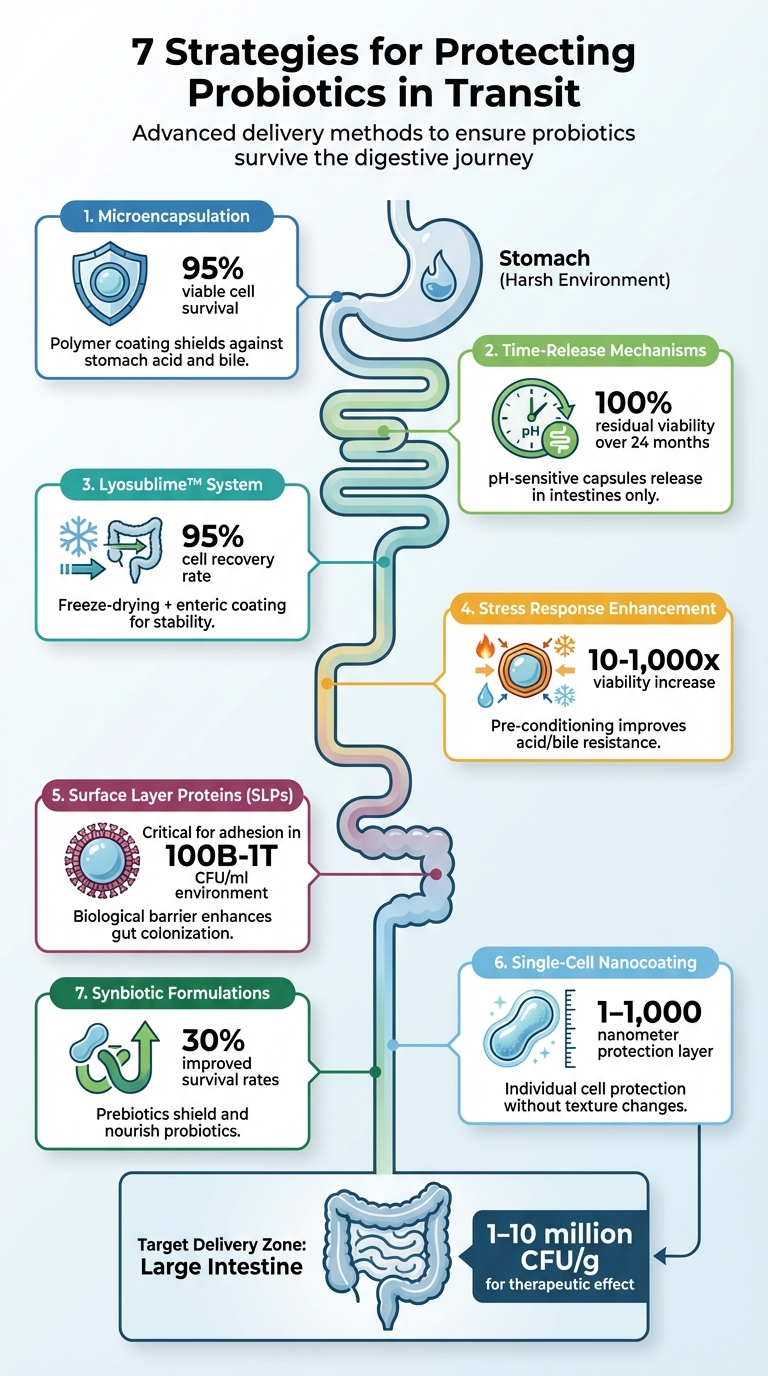
7 Probiotic Protection Strategies for Digestive Transit
A novel encapsulation technology to protect probiotics
1. Microencapsulation
Microencapsulation involves wrapping each probiotic cell in a protective polymer shell, offering a shield against the harsh environment of the digestive system.
Protection Against Gastric Acid and Bile
This protective coating acts as a barrier against gastric acid. Materials like alginate, chitosan, and whey protein create a seal that prevents acid from destroying the probiotics and blocks bile salts from damaging bacterial cell membranes - key factors behind probiotic loss during digestion [1][2].
For instance, in April 2024, researchers studied Lactobacillus acidophilus LA-5® using enteric-coated hard gelatin capsules. They applied the co-polymer Eudragit L100-55 with a fluidized bed coater. The outcome? 95% of the viable cells survived the coating process, and the capsules stayed intact in simulated gastric fluid while disintegrating effectively in simulated intestinal fluid [7].
Enhanced Stability During Transit
Microencapsulation doesn’t just protect against digestive fluids - it also helps maintain the probiotics' stability during manufacturing, storage, and shipping. A study on Limosilactobacillus mucosae CNPC007 found that this method ensured survival rates above 7 log CFU/g even after exposure to simulated digestion [6].
Optimized Delivery to the Gut
Modern enteric coatings utilize pH-sensitive materials that remain intact in the stomach's acidic environment but dissolve in the more alkaline conditions of the intestines. For example, Eudragit L100-55 stays stable in acidic pH levels and dissolves at pH 5.5 or higher, ensuring probiotics are released precisely in the intestines. This targeted delivery ensures that probiotics reach the large intestine in therapeutic concentrations of 1,000,000 to 10,000,000 CFU/g [1][7].
"Microencapsulation of probiotics into polymeric microcapsules successfully protects the probiotics from the harsh and changing conditions of the GI tract. Thus, microcapsules direct the delivery of living cargo without it losing its functionality to the target site." - Foods Journal, MDPI [8]
Next, we’ll dive into how time-release mechanisms work hand-in-hand with microencapsulation to ensure precise intestinal delivery.
2. Time-Release Mechanisms
Time-release mechanisms are designed to ensure probiotics are delivered to the gut at just the right time. Unlike regular capsules that dissolve quickly in the stomach, these advanced systems use pH-sensitive materials to keep probiotics intact until they reach the intestines.
Protection Against Gastric Acid and Bile
These capsules are equipped with enteric coatings, which act as a shield against harsh stomach acids and bile salts. The coating remains intact in the stomach's acidic environment and only dissolves once it encounters the higher pH levels in the intestines. This ensures the probiotics are released exactly where they’re needed.
"Enteric coated capsules can offer gastric protection whilst minimizing viability losses associated with the enteric coating process." - Heliyon [7]
For example, technologies like DRcaps™ have shown impressive results, maintaining 100% residual viability over a 24-month shelf-life. This demonstrates how effective time-release systems can be in preserving probiotic potency during storage and digestion [5].
Optimized Delivery to the Gut
The main benefit of time-release mechanisms is their ability to deliver probiotics directly to the large intestine. By bypassing the stomach, they help maintain therapeutic concentrations of probiotics - ranging from 1,000,000 to 10,000,000 CFU/g - necessary for colonization and health benefits [1].
"Encapsulation is a useful technique to protect probiotics from the bile salts... and improve the delivery of probiotics to large intestine in sufficient amounts for colonization and proliferation." - Amal Bakr Shori [2]
Up next, we’ll dive into how the Lyosublime™ delivery system takes probiotic survival and absorption to the next level.
3. Lyosublime™ Delivery System
The Lyosublime™ system takes probiotic protection to the next level by combining freeze-drying with a pH-sensitive release mechanism. This dual-layer approach pairs controlled freeze-drying with an enteric coating, ensuring probiotics are shielded during storage, transit, and their journey through the digestive system. By building on earlier time-release methods, this system enhances both storage stability and precise delivery to the gut.
Protection Against Gastric Acid and Bile
The enteric coating, made with Eudragit L100-55, is designed to withstand the acidic environment of the stomach (pH 2), effectively protecting probiotics from gastric acid and bile salts [7][2].
Stability for Long-Term Storage
Through controlled freeze-drying via sublimation, the system stabilizes probiotics for extended periods without refrigeration. This process ensures up to 95% recovery of viable probiotic cells [7].
Targeted Gut Delivery
The enteric coating remains intact in the stomach but dissolves at intestinal pH levels, ensuring probiotics are released where they can colonize and thrive [7].
Begin Rebirth RE-1™ incorporates the Lyosublime™ delivery system to safeguard its 500 billion CFU per serving. This ensures that probiotics remain viable from production to consumption, without requiring refrigeration, for optimal gut health.
4. Stress Response Enhancement
Stress response techniques prepare probiotics to endure the harsh conditions of digestion. By exposing bacterial cultures to controlled stress during manufacturing, their ability to survive and thrive is significantly improved.
Boosting Stability During Transit
When probiotics face stress, they produce heat shock proteins (HSPs) like DnaK, GroEL, and GroES, which shield their cellular structures from damage. For instance, exposing cultures to 113°F (45°C) for 30–90 minutes can increase their viability by 10–1,000 times [13]. Similarly, subjecting probiotics to cold stress has shown remarkable results, improving cell survival by 2 log units for Lactiplantibacillus plantarum and up to 5 log units for Lacticaseibacillus paracasei [13].
Defense Against Gastric Acid and Bile
Stress-adapted probiotics develop robust mechanisms to handle the digestive system's challenges. They activate F1F0-ATPase proton pumps to expel excess hydrogen ions and modify their membranes with more saturated fatty acids, which strengthens their resistance to acid and bile [13].
"Adaptation of low pH is one of the main targets during biomass production of probiotics as it improves acid resistance during probiotic in vivo application." – Springer Nature Review [13]
Enhancing Probiotic Viability and Effectiveness
These stress adaptations ensure that probiotics deliver at least 10,000,000 CFU per gram, meeting the levels needed for therapeutic benefits [13]. Additionally, stress-adapted strains produce more exopolysaccharides (EPS), which act as protective barriers during their journey through the stomach and small intestine. This layered protection ensures that a higher number of viable bacteria reach the large intestine, where they can colonize and provide health benefits.
sbb-itb-1bbfe7f
5. Surface Layer Protein Optimization
Surface layer proteins (SLPs), like SlpA, add an extra shield of protection for probiotics as they journey through the challenging environment of the gastrointestinal tract. These proteins form a biological barrier, safeguarding probiotic cells from mechanical damage and acidic conditions.
Protection Against Gastric Acid and Bile
SLPs act as a protective sieve, reducing direct exposure to stomach acid and bile. This reinforcement of the bacterial cell wall helps probiotics endure the stomach's harsh conditions, where transit can last anywhere from 5 minutes to 2 hours [13]. Once in the intestines, this same protective layer aids in the critical process of cell adhesion.
Enhanced Stability During Transit
Studies on Lactobacillus acidophilus NCFM reveal that disabling SlpA significantly weakens its ability to adhere to intestinal epithelial cells. Similarly, Lactobacillus helveticus uses SlpA to bind to mucins and intestinal cells, ensuring secure attachment during transit. This is particularly vital considering the colon's highly competitive environment, with bacterial densities ranging between 100 billion and 1 trillion CFU/ml [9].
Improved Probiotic Viability and Efficacy
Optimizing SLP expression not only boosts survival in the small intestine but also strengthens adhesion capabilities. This enhancement works in tandem with physical encapsulation and stress adaptations, ensuring probiotics can survive the journey and effectively colonize the gut. Beyond their protective role, SLPs interact with host immune cells, supporting innate immunity and maintaining mucosal health. Even when degraded, SLP fragments may provide additional postbiotic benefits [12][13].
6. Single-Cell Nanocoating
Single-cell nanocoating steps in as a cutting-edge solution for protecting probiotics at the individual cell level. By applying an ultra-thin protective layer (ranging from 1 to 1,000 nanometers) to each probiotic cell, this method ensures their survival without altering the product's texture. This precise approach works alongside other advanced delivery techniques to safeguard probiotics as they journey through the digestive system.
Protection Against Gastric Acid and Bile
The secret lies in the nanocoating's ability to act as a physicochemical shield against stomach acid and bile salts. Crafted with pH-responsive polymers, the coating stays intact in highly acidic environments (below pH 3) and dissolves when the pH rises above 6, ensuring probiotics are released exactly where they are needed. As Pedro Brivaldo Viana da Silva from the University of São Paulo explains, "The viability of microorganisms can be severely compromised during processing, storage, and particularly in the gastrointestinal tract, due to exposure to the acidic pH of the stomach, digestive enzymes, bile salts, and oxygen" [15].
Beyond gastric acid, the coating also defends against bile salts in the small intestine, offering a level of protection tailored to individual cells - something bulk encapsulation methods can't achieve [15][3].
Optimized Delivery to the Gut
The nanocoating doesn't just protect; it also enhances delivery. By incorporating mucoadhesive polymers like chitosan, it helps probiotics stick to the intestinal wall, increasing their chances of colonization and interaction with the host's immune system. For example, researchers have used layer-by-layer assembly with chitosan-alginate coatings on Escherichia coli Nissle 1917, demonstrating improved stability throughout digestion [15][3].
Improved Probiotic Viability and Efficacy
For probiotics to be effective, they need to reach the gut in concentrations of 100 million to 1 billion CFU. Single-cell nanocoating ensures these levels by protecting probiotics from light, oxygen, and moisture during storage and transit. Unlike traditional microencapsulation, which can sometimes result in an unpleasant gritty texture, this nanometric coating maintains both the product's quality and the precision needed to protect each cell individually.
7. Synbiotic Formulation Integration
Synbiotic formulations bring together probiotics and prebiotics in a single system that performs better than either component on its own. This pairing creates a protective environment where prebiotic fibers act as both a shield and an energy source for probiotics as they travel through the digestive system [10][8].
Enhanced Stability During Transit
Adding prebiotics like inulin, resistant starch, and trehalose to the encapsulation matrix strengthens it against harsh conditions like stomach acid and bile salts. Studies reveal that probiotic survival rates improve by up to 30% when a synbiotic alginate and starch matrix is used compared to standard methods [14].
"The incorporation of prebiotics like inulin, hi-maize, trehalose, resistant starch, etc. into the encapsulation wall material increases its resistance and the preserved viability of probiotics in extreme environments of the GI tract."
- MDPI Foods Journal [8]
Research highlights the effectiveness of specific combinations. For example, Lactobacillus acidophilus encapsulated in a synbiotic matrix made of alginate, starch, and chitosan remained stable for up to 135 days in freeze-dried form. Additionally, these synbiotic mixtures showed improved probiotic survival during 120 minutes of simulated gastric exposure [14]. This enhanced matrix not only protects probiotics during their journey but also prepares them for successful colonization in the gut.
Optimized Delivery to the Gut
Beyond surviving transit, synbiotic formulations ensure probiotics reach their intended destination. The prebiotic component plays a dual role: shielding probiotics during their journey and providing a fermentable energy source upon arrival in the large intestine. This energy source is crucial for effective colonization.
The difference between "complementary" and "synergistic" synbiotics is key here.
"A synergistic synbiotic is a synbiotic in which the prebiotics selectively enrich a supplemented probiotic in the gut."
- You-Tae Kim, University of California-Davis [16]
By pairing specific probiotics with their ideal prebiotics, these formulations ensure the strains have an exclusive energy supply when they reach the gut, avoiding competition with other bacteria.
Products like Begin Rebirth RE-1™ illustrate this approach. Their 3-in-1 eubiotic synbiotic formulation combines 500 billion CFU of Human Origin Strains with 4.5g of prebiotic fiber (GOS & Inulin), all delivered using the proprietary Lyosublime™ system.
Enhanced Viability and Efficacy
For probiotics to be effective, they must maintain at least 1,000,000 CFU per gram throughout their shelf life and digestion [11][8]. Synbiotic integration helps achieve this by maintaining an optimal internal pH and supporting the production of key metabolites like short-chain fatty acids once the probiotics reach the gut [8]. This is essential, as the majority of immune activity occurs in the gut [17]. The built-in protection of synbiotic formulations ensures that probiotics consistently reach the therapeutic levels needed to promote gut health effectively.
Conclusion
The effectiveness of probiotics heavily depends on their ability to survive the challenging journey through the digestive system. The seven strategies we've discussed tackle specific obstacles along the way - from enduring the harsh acidic environment of the stomach to resisting the bile salts that can reduce their viability [18][4].
Together, these strategies form a multi-layered defense system. Techniques like microencapsulation and single-cell nanocoating create protective barriers around the probiotics, while time-release mechanisms ensure they remain intact until they reach the intestines. Stress response enhancement prepares the bacteria during manufacturing to better handle digestive stresses, and optimizing surface layer proteins improves their ability to adhere to the intestinal lining [5][19].
"Providing probiotic living cells with a physical barrier against adverse conditions is an approach currently receiving considerable interest."
– Gildas K. Gbassi, Laboratoire de Conception et Application de Molécules Bioactives [4]
Navigating these digestive challenges is critical for probiotics to deliver therapeutic benefits. Research shows that oral doses exceeding 1 billion CFUs per day are generally needed to restore gut bacterial balance [5]. However, without advanced delivery methods, many of these cells are destroyed in the stomach. For instance, enteric coating technologies using co-polymers like Eudragit L100-55 can recover up to 95% of viable cells [7], whereas unprotected probiotics often face significant losses.
Innovative delivery systems, such as the Lyosublime™ process featured in Begin Rebirth RE-1™, integrate these protective strategies to ensure that a high number of viable cells reach the intestines. By overcoming digestive barriers, these technologies enable probiotics to colonize effectively and support immune health, delivering measurable benefits where they matter most.
FAQs
What is microencapsulation, and how does it help probiotics survive digestion?
Microencapsulation involves covering probiotics with a protective coating to safeguard them from the challenging environment of the digestive system. This coating acts as a shield, helping probiotics survive exposure to stomach acid and bile salts, so they stay alive and functional by the time they reach the gut.
This process boosts the stability of probiotics during digestion, making them more effective in promoting gut health and supporting overall wellness.
What is the Lyosublime™ system, and how does it help probiotics work better?
The Lyosublime™ system is a cutting-edge delivery method featured in Begin Rebirth RE-1™. Its purpose? To help probiotics survive the harsh environment of the digestive system. By shielding these live bacteria from stomach acid and bile, it boosts their chances of safely reaching the gut.
This protective system ensures the probiotics remain effective, aiding in restoring balance to the gut microbiome. It also supports immune health and helps address digestive challenges like dysbiosis. Lyosublime™ plays a central role in Begin Rebirth RE-1™, making it a powerful tool for a quick and efficient microbiome reset.
Why are synbiotic supplements essential for maximizing probiotic benefits?
Synbiotic supplements bring together probiotics (the "good" bacteria) and prebiotics (the nutrients that feed them), creating a powerful partnership that helps probiotics survive and thrive in the gut. Prebiotics act as fuel, keeping probiotics active and effective as they navigate the digestive system.
This pairing also strengthens probiotics, improving their ability to withstand processing, storage, and the stomach's acidic environment. By ensuring more live bacteria make it to the gut intact, synbiotic supplements amplify the benefits of probiotics - like promoting gut health, supporting the immune system, and tackling gut imbalances such as dysbiosis.