

Stress impacts your gut health in ways you might not expect. It disrupts the balance of gut bacteria, weakens the gut lining, and increases inflammation, which can affect your mood, immune system, and overall well-being. Prebiotics, probiotics, and postbiotics offer a science-backed way to restore balance, reduce stress, and improve gut-brain communication.
Key Takeaways:
- Stress and the Gut: Chronic stress increases harmful bacteria, reduces beneficial strains, and weakens the gut barrier, leading to inflammation and mood issues.
- Gut-Brain Connection: Your gut produces neurotransmitters like serotonin and GABA, which regulate mood and stress resilience.
-
Gut Health Strategies:
- Prebiotics: Feed beneficial bacteria and boost microbial diversity (e.g., inulin, FOS, GOS).
- Probiotics: Replenish good bacteria and support neurotransmitter production (e.g., Lactobacillus, Bifidobacterium).
- Postbiotics: Reduce inflammation and strengthen the gut lining (e.g., SCFAs like butyrate).
Quick Fact:
A 2022 study found that a diet rich in prebiotics and fermented foods reduced perceived stress by 32% in just 4 weeks.
Want to recover from stress faster? Combining prebiotics, probiotics, and postbiotics - like in Begin Rebirth RE-1™ - offers a targeted solution to rebalance your gut microbiome and improve mental well-being.
How to Fix Your Brain-Gut Connection: Anxiety and the Brain-Gut Microbiome Axis
How Stress Disrupts Your Gut Microbiome
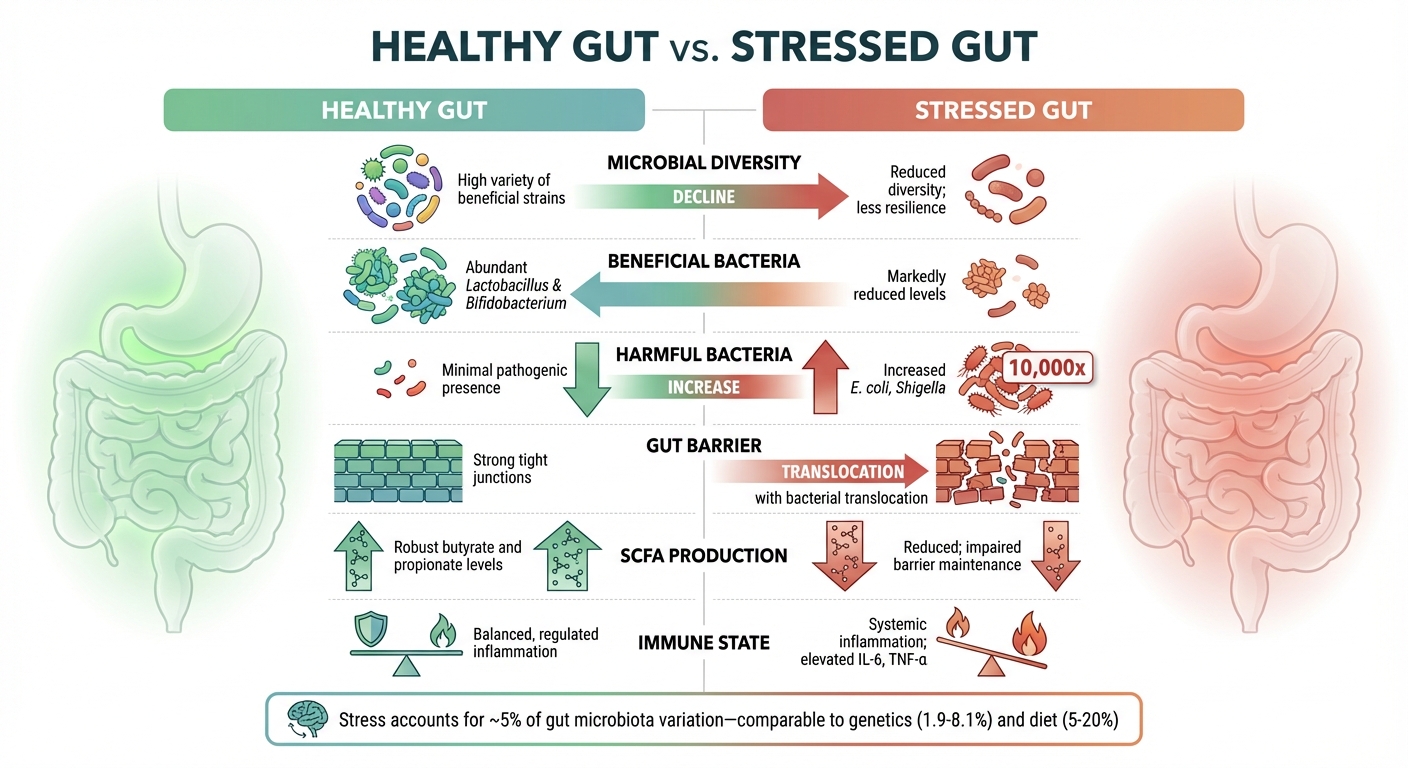
Healthy vs Stressed Gut: Key Differences in Microbiome Health
Chronic stress has a profound impact on your gut microbiota. In fact, stressful life events account for roughly 5% of the variation in gut microbiota composition - a level comparable to the influence of genetics (1.9% to 8.1%) or diet (5% to 20%) [13]. These changes can lead to far-reaching effects that go well beyond just digestive issues.
The Gut-Brain Axis and Stress
Your gut and brain are in constant communication through the gut-brain axis, with the vagus nerve acting as the main highway between the two systems [8][9]. When stress hits, your hypothalamic-pituitary-adrenal (HPA) axis swings into action, releasing cortisol and catecholamines like norepinephrine [8][10]. These stress hormones can wreak havoc on your gut environment.
Norepinephrine, in particular, promotes the growth of harmful bacteria. Studies show that stress hormones can amplify the growth of pathogenic bacteria by up to 10,000 times within just 14 hours [12]. For example, norepinephrine supports the proliferation of Escherichia coli and enhances its ability to stick to the intestinal lining [3]. At the same time, beneficial bacteria like Lactobacillus and Bifidobacterium see a sharp decline [3][8]. High levels of perceived stress are also linked to an increase in harmful bacteria such as Escherichia and Shigella [13].
Stress hormones don’t stop there - they also weaken the gut barrier by reducing levels of occludin and zonulin. This makes the gut more permeable, allowing lipopolysaccharides (LPS) and bacteria to escape into the bloodstream, which triggers systemic inflammation [3][8][10]. Since about 90% of the body’s serotonin is produced in the gut [8], this disruption can directly affect mood and cognitive function.
These immediate hormonal effects often pave the way for long-term gut health issues.
Long-Term Effects of Chronic Stress on Gut Health
When stress becomes chronic, it sets off a damaging cycle of gut imbalance and inflammation. Prolonged stress reduces the production of short-chain fatty acids (SCFAs) like butyrate and propionate [8][11]. These SCFAs are essential for nourishing intestinal cells and maintaining both the gut and blood-brain barriers [8][2]. Without sufficient SCFAs, the immune system struggles to manage inflammation, leaving the brain more susceptible to neuroinflammation. This can result in a host of problems, including digestive issues, weakened immunity, fatigue, and mood disorders.
| Feature | Healthy Gut | Stressed Gut |
|---|---|---|
| Microbial Diversity | High variety of beneficial strains | Reduced diversity; less resilience |
| Beneficial Bacteria | Abundant Lactobacillus & Bifidobacterium | Markedly reduced levels |
| Harmful Bacteria | Minimal pathogenic presence | Increased E. coli, Shigella (up to 10,000x) |
| Gut Barrier | Strong tight junctions | Weakened; "leaky gut" with bacterial translocation |
| SCFA Production | Robust butyrate and propionate levels | Reduced; impaired barrier maintenance |
| Immune State | Balanced, regulated inflammation | Systemic inflammation; elevated IL-6, TNF-α |
These shifts create a less resilient gut environment, making it harder for the body to maintain overall health and wellbeing.
How Prebiotics, Probiotics, and Postbiotics Support Stress Recovery
Stress can wreak havoc on your gut, but there’s a three-step approach that can help restore balance: prebiotics to fuel beneficial bacteria, probiotics to replenish them, and postbiotics to reduce inflammation. Research highlights the power of combining prebiotics and probiotics - known as synbiotics - to provide more consistent recovery from stress-related behavioral issues than using either one alone [4].
These three elements support recovery by working through the gut-brain axis. They help restore microbial diversity, strengthen the intestinal barrier, and produce neurotransmitters that regulate mood [5][6]. In June 2021, researchers at the Icahn School of Medicine at Mount Sinai showed that a synbiotic containing Lactobacillus plantarum ATCC 793, Bifidobacterium longum ATCC 15707, and a grape-derived prebiotic reduced depressive-like behavior in mice. This was achieved by lowering inflammatory gene expression in the brain - something neither the probiotic nor prebiotic could achieve alone [4]. Let’s break down how each component contributes to stress recovery.
Prebiotics: Nourishing Beneficial Bacteria
Prebiotics are non-digestible fibers that act as food for beneficial gut bacteria, like Bifidobacterium and Lactobacillus. By fueling these bacteria, prebiotics promote the production of short-chain fatty acids (SCFAs) such as butyrate and propionate, which provide energy to the cells lining the intestines and support immune regulation through T regulatory cells [2][14].
Common sources of prebiotics include inulin, fructooligosaccharides (FOS), and galactooligosaccharides (GOS) [5][6]. Research suggests that around 10 grams of FOS or 7 grams of GOS daily can effectively support gut health [7]. By selectively feeding beneficial bacteria, prebiotics help reverse the microbial imbalances caused by stress and increase overall microbial diversity [4][14].
Probiotics: Replenishing Good Bacteria
Probiotics take the next step by directly replenishing beneficial bacterial populations. Certain strains, such as Lactobacillus and Bifidobacterium, not only restore gut health but also produce neurotransmitters like GABA, serotonin, and dopamine. These compounds play a critical role in mood regulation and central nervous system function, communicating with the brain via the vagus nerve and other pathways [5][6].
"Psychobiotics are probiotics that, when ingested in adequate amounts, produce a health benefit in patients suffering from psychiatric illness." – Dinan et al. [6]
Specific strains, including Lactobacillus helveticus R0052 and Bifidobacterium longum R0175, have been found to lower urinary cortisol levels and improve mood [5]. Probiotics also compete with harmful bacteria for space in the gut, preventing pathogens from taking hold [14]. For best results, probiotic-rich foods should contain at least 7 log CFU and be consumed in servings of about 100 grams or milliliters daily [7].
Postbiotics: Reducing Inflammation and Supporting Recovery
Postbiotics, the byproducts of probiotic bacteria, offer benefits without needing to be alive [5][6]. They strengthen the intestinal barrier, reduce inflammation, and fine-tune immune responses.
"Postbiotics might comprise both the cells and the fermentation broth in which they are made including short chain fatty acids (SCFAs), vitamins, organic acids, peptides, oligosaccharides, and other cell constituents." – You-Tae Kim, Department of Food Science and Technology, University of California-Davis [5]
Postbiotics help tighten the intestinal lining by boosting proteins like zonula occludens-1, occludin, and claudins, which seal gaps created by stress [2][5][14]. This prevents bacteria from leaking into the bloodstream, where they could trigger inflammation. They also encourage immune cells to release anti-inflammatory cytokines like IL-10 while reducing inflammatory markers such as TNF-α and IL-6 [5][6][7]. Additionally, SCFAs travel to the brain, where they regulate immune function and reduce neuroinflammation [5][7]. By reinforcing the gut barrier, postbiotics maintain the gut-brain communication essential for mood stability.
| Component | Primary Function in Stress Recovery | Key Examples |
|---|---|---|
| Prebiotics | Nourish beneficial bacteria and boost microbial diversity | Inulin, FOS, GOS, resistant starch [5][6] |
| Probiotics | Replenish good bacteria and produce mood-regulating compounds | Lactobacillus, Bifidobacterium [5][6] |
| Postbiotics | Reduce inflammation, support gut lining, and enhance gut-barrier strength | SCFAs (butyrate), heat-killed cells [5][14] |
sbb-itb-1bbfe7f
Research on Gut Health Interventions for Stress Recovery
Clinical research has shown that prebiotics, probiotics, and postbiotics can play a meaningful role in improving stress-related issues. These interventions act through the gut-brain axis, helping to reduce fatigue, boost immune function, and lower stress hormones like cortisol. Controlled studies highlight how gut-focused approaches can effectively address stress symptoms.
Probiotics for Reducing Stress-Related Fatigue and Mood Issues
Certain probiotic strains, often called psychobiotics, have been shown to improve mental health by influencing the brain-gut-microbiome axis and regulating key neurotransmitters such as GABA, serotonin, and dopamine [6][7].
In July 2023, a study revealed that taking Lactobacillus plantarum PS128 daily for 30 days reduced depression symptoms, improved sleep, and alleviated fatigue in participants [7]. Another study, conducted in January 2025, focused on 79 students preparing for oral exams. Over four weeks, they consumed Lacticaseibacillus rhamnosus CNCM I-3690 (about 200 billion CFU per day), which led to lower self-reported anxiety and stress levels. Additionally, it helped maintain gut microbiome diversity, which often declines under stress [15].
"Psychobiotics contribute to changes in concentrations of brain neurotransmitters and proteins, reduction of cortisol levels, and alterations in serum cytokine levels, which consequently lead to behavioral changes." – Agata Chudzik, Medical University of Lublin [6]
Different strains of probiotics show varying levels of effectiveness. For example, Bifidobacterium species are particularly effective at reducing anxiety, with a Standardized Mean Difference (SMD) of -0.80, while Lactobacillus strains show an SMD of -0.49 [17]. Typically, the benefits of probiotic supplementation become noticeable after 4 to 8 weeks of consistent use [7][15]. Prebiotics, meanwhile, play a complementary role by enhancing microbial diversity and supporting immune health.
Prebiotics for Immune Function and Microbial Diversity
Prebiotics, unlike probiotics, create an environment in the gut that helps beneficial bacteria thrive. By restoring gut microbiota diversity - often depleted during chronic stress - prebiotics aid in stress recovery [4][10]. When fermented by gut bacteria, prebiotics produce short-chain fatty acids (SCFAs) like butyrate and propionate. These SCFAs cross the intestinal barrier to influence immune responses and central nervous system activity [6][7].
In October 2022, a trial involving 45 healthy adults explored the effects of a "psychobiotic diet." This diet included 6–8 servings of prebiotic-rich fruits and vegetables and 2–3 servings of fermented foods daily for 4 weeks. Participants reported a 32% reduction in perceived stress, compared to a 17% reduction in the control group [16]. Notably, those who closely followed the diet experienced even greater stress relief.
Specific prebiotics offer unique benefits. For instance, Bimuno®-galactooligosaccharides (B-GOS) have been shown to lower waking cortisol levels and reduce attentional bias toward negative information, effectively dampening the neuroendocrine stress response [18][19].
Postbiotics for Lowering Cortisol and Inflammation
Postbiotics, which include heat-killed microorganisms and their metabolites, complement the effects of prebiotics and probiotics. These compounds strengthen the gut barrier, regulate immune responses, and engage the nervous system to address stress-related symptoms [6]. Unlike probiotics, postbiotics work without requiring live bacteria.
Research on SCFAs produced during fiber fermentation (equivalent to 10–20 grams of fiber) has demonstrated their ability to reduce cortisol levels in response to psychosocial stress in healthy men [20]. Additionally, heat-killed Lactobacillus paracasei PS23 has been shown to increase Brain-Derived Neurotrophic Factor (BDNF) and modulate glucocorticoid receptors in animal models, reducing anxiety- and depression-like behaviors [6].
These metabolites also interact with G-protein coupled receptors, helping to regulate inflammation and the hypothalamic-pituitary-adrenal (HPA) axis [7][20]. By lowering pro-inflammatory cytokines like IL-6 and TNF-α, postbiotics can help break the cycle of chronic stress and inflammation [6][10]. These findings set the stage for the strategies discussed in the next section.
Begin Rebirth RE-1™ for Rapid Microbiome Reset
Stress can wreak havoc on your gut health, making targeted solutions a necessity. When stress throws your gut microbiome out of balance, a focused intervention can restore harmony much faster than relying on dietary changes alone. Enter Begin Rebirth RE-1™, a clinically supported synbiotic that combines prebiotics, probiotics, and postbiotics in one formula, designed specifically to address stress-induced gut issues. Here's why it stands out.
Why Begin Rebirth RE-1™ Works
Each serving of Begin Rebirth RE-1™ delivers a potent 500 billion CFU using Human Origin Strains (HOSt™). These strains, derived from the human gut, are naturally adapted to thrive in the intestinal environment, making them highly effective at colonization [22]. The right CFU levels are key to supporting the gut-brain-microbiome connection [6] [7]. Additionally, the Lyosublime™ delivery system protects these bacteria as they pass through stomach acid, ensuring they reach the colon intact [22] [23].
A June 2021 study highlighted the unique effectiveness of this synbiotic combination, showing it significantly reduces inflammatory gene expression in the brain. The research found that Begin Rebirth RE-1™ normalized gut microbiota diversity after chronic stress and outperformed its individual components [4].
"The synbiotic promoted more consistent and robust resilience to stress-induced behavioral impairments compared to its components." – National Center for Complementary and Integrative Health (NCCIH) [4]
Each sachet also includes 4.5 grams of fiber from galactooligosaccharides (GOS) and inulin. These fibers nourish beneficial bacteria like Bifidobacterium and Lactobacillus, while producing short-chain fatty acids that strengthen the gut barrier and reduce inflammation [7] [24]. The postbiotic elements get to work quickly - studies show postbiotic supplementation can lower serum IL-1β levels by 1.79 and Malondialdehyde (MDA) levels by 30.5% within just 7 days [21].
Understanding how Begin Rebirth RE-1™ works is the first step to using it effectively for stress recovery.
Using Begin Rebirth RE-1™ for Stress Recovery
Begin Rebirth RE-1™ offers flexible protocols to suit various recovery needs.
- The 7-day rapid reset is ideal for acute stress, helping to quickly address inflammation and oxidative stress markers [21].
- The 4-week stabilization plan is better suited for more significant disruptions, reducing perceived stress by 32% and stabilizing microbial fluctuations over time [1]. This period allows probiotics to attach to your intestinal lining and interact with your existing microbiome [22].
- For long-term recovery from chronic stress, the 12-week comprehensive reset restores gut microbiota diversity and supports sustained improvement in the gut-brain connection. This protocol is particularly helpful if chronic stress has caused major changes to your gut ecosystem [24] [25].
To use, mix one sachet daily with water or a cool beverage. The product doesn't require refrigeration, making it convenient for everyday use, whether you're at home or on the go. Consistency is key to building resilience and maintaining a balanced microbiome.
Conclusion
Stress can wreak havoc on your gut, sparking inflammation, weakening the gut lining, and throwing off its natural balance. But here’s the good news: prebiotics, probiotics, and postbiotics can work together to restore harmony, strengthen your gut barrier, and support mood-regulating neurotransmitters. Instead of just covering up symptoms, this approach tackles the root causes of stress-related gut issues.
Recovering from these disruptions requires a well-rounded strategy. Studies show that using a synbiotic approach - combining probiotics and prebiotics - can improve microbial diversity and reduce inflammation, helping your body better adapt to stress.
Begin Rebirth RE-1™ offers a tailored solution to meet your recovery goals. With options like a 7-day reset or a 12-week program for deeper restoration, you can choose the plan that best fits your needs.
FAQs
How do prebiotics, probiotics, and postbiotics support recovery from stress-related gut disruptions?
Prebiotics, probiotics, and postbiotics work hand in hand to bring balance to the gut microbiome, a crucial player in managing stress and promoting overall well-being. Prebiotics are non-digestible fibers that act as fuel for beneficial gut bacteria, encouraging the production of short-chain fatty acids (SCFAs) like butyrate. These SCFAs play a key role in strengthening the gut barrier and calming inflammation. Probiotics, which are live beneficial bacteria such as Lactobacillus plantarum and Bifidobacterium longum, support gut health by outcompeting harmful bacteria, aiding immune function, and helping regulate the body’s response to stress. Postbiotics, which include metabolites and fragments of bacterial cell walls, enhance the gut-brain connection, reducing inflammation and boosting the production of mood-regulating neurotransmitters like serotonin and GABA.
When combined, these elements work synergistically to improve gut health, ease stress-related symptoms, and build resilience. Begin Rebirth RE-1™ brings together prebiotics, probiotics, and postbiotics in a clinically-supported synbiotic blend designed to reset the gut microbiome and support stress recovery in as little as 7 days.
How does the gut-brain axis affect stress recovery?
The gut-brain axis is a two-way communication network linking your brain and the trillions of microbes living in your gut. This connection plays a vital role in how your brain and gut respond to stress, mood changes, and overall mental health. When you're under stress, elevated cortisol levels, changes in gut permeability, and shifts in microbial balance can disrupt this system, potentially leading to heightened anxiety and mood-related challenges.
Bringing balance back to your gut microbiome can help recalibrate this connection, reducing inflammation tied to stress and supporting the production of helpful compounds like short-chain fatty acids. Prebiotics, probiotics, and postbiotics - often referred to as synbiotics - are key players in this process. They promote a healthier microbiome, boost immune function, and help lower stress levels. Begin Rebirth RE-1™, a clinically supported synbiotic, is designed to quickly restore gut balance, strengthening the gut-brain connection and enhancing your resilience to stress.
Can Begin Rebirth RE-1™ support gut health after stress?
Yes, chronic stress can throw your gut microbiota out of sync, leading to discomfort and a range of related issues. Studies suggest that prebiotics, probiotics, and postbiotics can play a key role in rebalancing your gut by promoting healthy bacteria and easing stress-related symptoms.
Begin Rebirth RE-1™ brings these three together in a clinically-supported, 3-in-1 formula. This unique combination is designed to quickly reset your microbiome, boost immune health, and tackle gut imbalances - making it a strong choice for addressing gut concerns linked to stress.