

Your gut health and sleep are deeply connected. The gut-brain axis - a communication network between your gut and brain - plays a key role in regulating sleep. When your gut microbiome is imbalanced, it can disrupt sleep, and poor sleep can, in turn, negatively affect your gut bacteria. Here's what you need to know:
- Gut bacteria produce sleep-related neurotransmitters like serotonin, melatonin, and GABA, which influence your sleep-wake cycle.
- Diverse gut microbiomes improve sleep quality. Studies show higher diversity is linked to better sleep efficiency and fewer sleep disruptions.
- Imbalances in gut bacteria can lead to sleep issues like insomnia and sleep apnea, often due to inflammation and reduced production of beneficial metabolites like butyrate.
- Diet and lifestyle changes can improve both gut and sleep health. Fiber-rich foods, probiotics, and consistent sleep schedules help maintain balance.
The gut-sleep connection is a two-way street. Addressing one can improve the other, enhancing overall well-being.
Irregular Sleep and Harmful Gut Bacteria | Dr. Will Bulsiewicz Live Q&A
How the Gut Microbiome Affects Sleep
Your gut is home to bacteria that play a surprising role in regulating sleep. These tiny organisms produce neurotransmitters, metabolites, and immune signals that influence when you sleep and how well you rest. This connection underscores the importance of gut health when it comes to achieving quality sleep. Let’s dive deeper into how specific bacterial species and their byproducts impact your sleep patterns.
Bacterial Types and Their Effects on Sleep
Certain gut bacteria are directly involved in producing neurotransmitters that influence sleep. For example, families like Clostridiaceae and Turicibacteraceae are known to produce serotonin, a key precursor to melatonin - the hormone that governs your sleep-wake cycle. Probiotic strains such as Lacticaseibacillus rhamnosus can also significantly increase serotonin levels, signaling the brain via the vagus nerve [2].
However, not all bacteria work in your favor. Some species, like Escherichia coli, Limosilactobacillus vaginalis, and Morganella morganii, produce histamine, a neurotransmitter that promotes wakefulness [2]. On the flip side, strains of Lactobacillus and Bifidobacterium generate GABA, a neurotransmitter that calms brain activity and supports sleep [2][9]. The balance between these sleep-promoting and wake-promoting bacteria can make or break your ability to get a good night’s sleep.
Research backs this up. A study by Nova Southeastern University revealed that a higher diversity of Bacteroidetes and Firmicutes - two dominant bacterial groups - was strongly linked to better sleep efficiency (p=0.001) [4]. Simply put, a more diverse gut microbiome translates to better sleep quality.
But the story doesn’t end with neurotransmitters. Gut bacteria also produce metabolites that fine-tune sleep regulation in fascinating ways.
Gut Metabolites and Sleep Regulation
Short-chain fatty acids (SCFAs), especially butyrate, are critical players in sleep regulation. These metabolites are produced when gut bacteria ferment dietary fiber. Butyrate has the unique ability to cross the blood-brain barrier or signal through the vagus nerve, directly influencing orexin neurons in the brain’s lateral hypothalamic area - a region that controls wakefulness [8].
"Butyrate, a microbiota-derived metabolite, can promote sleep by modulating orexin neuronal activity in the lateral hypothalamic area in mice."
Insomnia studies have shown that patients with sleep issues often have lower levels of serum butyrate and a shortage of butyrate-producing bacteria compared to healthy sleepers [8]. Interestingly, your body absorbs most of the SCFAs produced by gut bacteria - only about 5% are excreted, while the rest are used for various metabolic and signaling processes [11]. Beyond their role in sleep, these metabolites strengthen the intestinal barrier, reducing the risk of "leaky gut", which can otherwise lead to inflammation that disrupts sleep. Animal studies have even demonstrated that butyrate supplementation can increase non-REM (NREM) sleep and shorten the time it takes to fall asleep [8].
Immune System Connections to Sleep and Gut Health
Your gut microbiome doesn’t just talk to your brain - it also communicates with your immune system, influencing sleep through immune signaling molecules called cytokines. For instance, Interleukin-1 beta (IL-1β) promotes sleep, while Interleukin-6 (IL-6) levels fluctuate depending on sleep loss or recovery [4].
The Nova Southeastern University study found a strong link between overall gut microbiome diversity and IL-6 levels (ρ = 0.612, p=0.001) [4]. However, this relationship is a two-way street. Sleep deprivation can increase gut permeability, allowing harmful molecules like lipopolysaccharides (LPS) from Gram-negative bacteria to enter the bloodstream. These LPS molecules can then activate Toll-like receptor 4 (TLR4) on microglia in the brain, triggering inflammation. While this can prolong non-REM sleep, it also risks causing neuroinflammation [2].
Even a single night of poor sleep can elevate pro-inflammatory markers like C-reactive protein (CRP) and tumor necrosis factor alpha (TNFα) [6]. But there’s hope: certain bacterial strains can help. For example, a December 2024 study involving 230 participants found that Lactobacillus plantarum JYLP-326 improved both insomnia and depressive symptoms by regulating gut microbiota metabolites and their impact on immune-inflammatory pathways [1].
Sleep Disorders and Gut Microbiome Imbalances
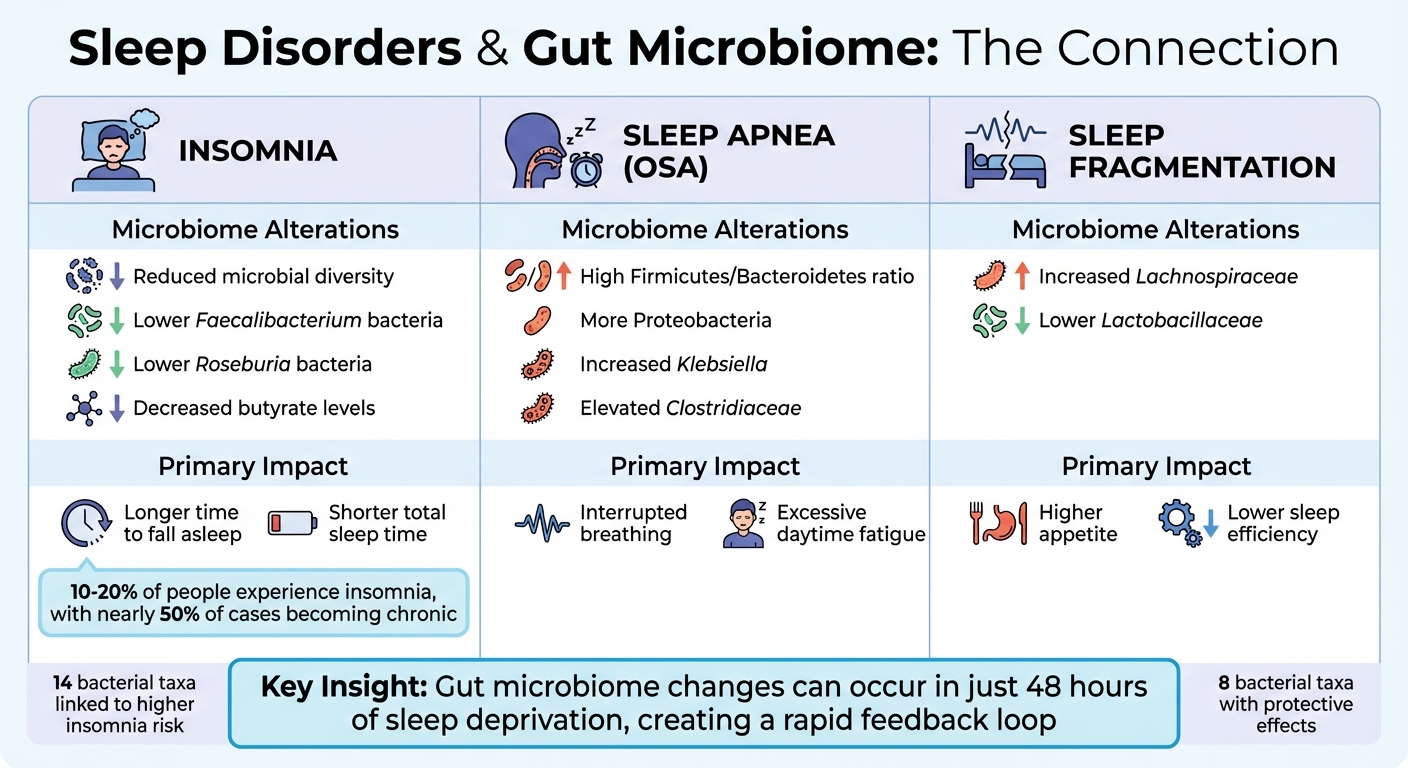
Sleep Disorders and Gut Microbiome Imbalances Comparison
The link between gut health and sleep is undeniable, and this connection becomes even more apparent when examining sleep disorders. Chronic sleep issues are often paired with noticeable changes in gut microbiome composition, particularly a drop in microbial diversity [2]. Research shows that 10%–20% of people experience insomnia, with nearly half of these cases becoming chronic [7]. These shifts in microbial diversity set the stage for specific changes seen in conditions like insomnia and sleep apnea.
Microbiome Changes in Insomnia and Sleep Apnea
For those dealing with insomnia, there’s a notable decline in SCFA-producing bacteria such as Faecalibacterium and Roseburia. This leads to lower levels of butyrate in the bloodstream [2][12], a key metabolite that helps regulate sleep by calming wake-promoting neurons in the brain.
Sleep apnea, on the other hand, presents a different microbial profile. Individuals with obstructive sleep apnea (OSA) often show a higher Firmicutes to Bacteroidetes ratio along with an increase in pro-inflammatory bacteria like Proteobacteria, Clostridiaceae, and Klebsiella [2]. These changes drive inflammation, which can worsen the breathing interruptions common in OSA. Additionally, specific bacterial groups such as Lachnospiraceae, Corynebacterium, and Blautia have been linked to poorer sleep efficiency and shorter total sleep duration [4][14].
How Dysbiosis Affects Sleep Quality
The impact of these microbial changes goes beyond composition - dysbiosis directly affects how well we sleep. When harmful bacteria outweigh beneficial ones, the gut barrier weakens, allowing lipopolysaccharides (LPS) to enter the bloodstream. This triggers inflammation that disrupts sleep patterns [12].
What’s even more striking is how quickly this gut-sleep cycle can take hold. Partial sleep deprivation can alter the gut microbiome in just 48 hours [4]. This rapid shift means even short-term sleep disruptions can lead to a feedback loop of poor gut health and worsening sleep. Studies using Mendelian randomization have identified 14 bacterial taxa linked to higher insomnia risk and 8 taxa associated with protective effects [7], proving that specific microbial imbalances can directly influence sleep quality.
| Sleep Disorder | Microbiome Alterations | Primary Impact |
|---|---|---|
| Insomnia | Reduced diversity; lower Faecalibacterium and Roseburia; decreased butyrate | Longer time to fall asleep; shorter total sleep time |
| Sleep Apnea (OSA) | High Firmicutes/Bacteroidetes ratio; more Proteobacteria and Klebsiella | Interrupted breathing; excessive daytime fatigue |
| Sleep Fragmentation | Increased Lachnospiraceae; lower Lactobacillaceae | Higher appetite; lower sleep efficiency |
The connection is clear: balancing the gut microbiome isn’t just about digestion - it’s a key part of managing and improving sleep disorders effectively.
sbb-itb-1bbfe7f
Ways to Improve Gut Health and Sleep
Improving gut health and sleep quality often go hand in hand, as these two systems are deeply interconnected through various biological pathways. Here’s a closer look at evidence-backed strategies to support both.
Dietary Approaches for Gut and Sleep Support
What you eat can have a profound impact on both your gut microbiome and how well you sleep. Research has introduced a Dietary Index for Gut Microbiota (DI-GM), which tracks 14 specific foods and nutrients associated with microbial diversity. Higher DI-GM scores have been linked to longer sleep durations and a reduced likelihood of short sleep patterns [16].
Fiber plays a starring role here. When gut bacteria ferment fiber, they produce short-chain fatty acids (SCFAs) like butyrate, acetate, and propionate, which are crucial for gut and brain health [17]. Butyrate, in particular, acts as a signaling molecule that helps regulate your sleep-wake cycles. A 2024 study from Peking University Sixth Hospital showed that giving mice a butyrate precursor called tributyrin significantly improved sleep disturbances caused by fecal microbiota transplants from human insomnia patients. The researchers found that butyrate suppressed orexinergic neurons in the hypothalamus, restoring normal sleep patterns [12].
To support SCFA-producing bacteria like Lachnospiraceae and Ruminococcaceae, which are often depleted during disrupted sleep, focus on eating a variety of prebiotic fibers. Foods rich in oligosaccharides and other fiber types are especially beneficial. Timing your meals can also make a difference - aligning food intake with natural circadian rhythms through time-restricted eating helps maintain the gut’s oscillatory bacterial composition [10]. These dietary tweaks can pave the way for more targeted interventions like synbiotics.
Using Synbiotics to Restore Balance
Synbiotics, which combine prebiotics, probiotics, and postbiotics, offer a powerful way to improve both gut health and sleep. These supplements work through the microbiota-gut-brain axis, a communication network involving neural, hormonal, and immune pathways [2][3].
Certain bacterial strains have been shown to improve sleep quality. For instance, a 2017 study found that taking L. casei Shirota (1×10¹¹ CFU) daily helped reduce sleep latency and improve sleep duration during stressful periods like exams [9][10].
One example of a synbiotic product is Begin Rebirth RE-1™, a clinically tested 3-in-1 formula. It combines prebiotics (4.5g of GOS and inulin fiber), probiotics with Human Origin Strains (HOSt™), and postbiotics to support neurotransmitter production (like serotonin and GABA), maintain SCFA levels, and reduce neuroinflammation [2][9][12]. Each serving delivers 500 billion CFU and comes in easy-to-use sachets for 7-day, 4-week, or 12-week reset programs.
For those who can’t tolerate live probiotics, postbiotics like heat-killed Lactobacillus gasseri CP2305 have shown similar benefits. They’ve been found to improve subjective sleep quality and reduce the time it takes to fall asleep [9].
| Biotic Type | Key Examples | Primary Sleep Benefit |
|---|---|---|
| Probiotics | B. longum, L. casei Shirota | Longer sleep; reduced latency during stress [5][9] |
| Prebiotics | Dietary fibers, Oligosaccharides | Prolonged NREM sleep; faster stress recovery [9] |
| Postbiotics | Heat-killed L. gasseri CP2305 | Better sleep scores; reduced waking after sleep onset [9] |
| Metabolites | Butyrate (SCFA) | Regulates orexin neurons; lowers neuroinflammation [12] |
By combining synbiotics with healthy lifestyle habits, you can maximize the benefits for both your gut and sleep.
Lifestyle Changes for Better Gut and Sleep Health
Your daily habits also play a big role in the gut-sleep connection. The gut microbiome operates on a rhythmic activity cycle influenced by external factors like light and food [18].
"Along with diet and exercise, sleep is the other part of that trifecta that is really important for our overall wellbeing and our way of navigating the world." - John Cryan, Ph.D., Professor and Chair of the Department of Anatomy & Neuroscience at University College Cork [15]
To support this rhythm, maintain consistent sleep and meal schedules. Over 60% of gut bacteria follow daily oscillatory patterns, which can be disrupted by irregular sleep [2]. Timed meals help reinforce these natural cycles.
Light exposure is another key factor. Reduce artificial light and screen time in the evening to avoid interfering with the suprachiasmatic nucleus, a part of the brain that regulates sleep. Interestingly, the gut produces 400 times more melatonin than the pineal gland, underscoring its critical role in sleep regulation [18].
Stress management is equally important. Chronic stress triggers the release of pro-inflammatory cytokines like IL-6 and IL-1β, which can disturb both gut health and sleep [14]. Probiotics and postbiotics can help by lowering cortisol levels and calming the nervous system, especially during high-stress situations [9]. Mindfulness and relaxation techniques can further enhance this effect.
Lastly, regular physical activity supports circadian rhythms and reduces inflammation [13][18]. Avoid eating late at night and stick to consistent meal intervals to allow your gut microbiome to function optimally. Meal timing acts as a key signal for your body’s internal clock, helping to keep everything in sync.
Conclusion: Addressing Both Gut and Sleep Health
Main Findings from Current Research
Research highlights a fascinating connection between gut health and sleep quality, showing they influence each other in a two-way relationship. Gut imbalances, or dysbiosis, can disrupt sleep patterns, while poor sleep can further upset the balance of gut microbes [2][6][7]. Clinical studies reveal that probiotics can improve sleep quality, as evidenced by a 2.10-point average reduction in Pittsburgh Sleep Quality Index (PSQI) scores. They also contribute to better mental health, lowering depression scores by 7.72 points on the Hamilton Depression Scale [1].
The connection lies in shared biological pathways. For example, the gut plays a critical role in serotonin production, a key neurotransmitter for sleep regulation. Research also indicates that a diverse microbiome is linked to improved sleep efficiency, longer sleep duration, and fewer nighttime disturbances [4].
"The gut microbiota is a strong candidate for the initiating link between dysfunctional sleep, disrupted body rhythms and poor health." - Sleep Medicine Reviews [6]
These findings open the door to practical strategies for improving both gut and sleep health.
Action Steps for Readers
To support both your gut and sleep, start with simple dietary adjustments. Eating more fiber-rich foods can nourish short-chain fatty acid (SCFA)-producing bacteria, while maintaining consistent meal times helps align your gut’s circadian rhythm. Adding tryptophan-rich foods - such as fish, nuts, and seeds - can also boost neurotransmitter production [18].
For those seeking a more targeted solution, clinically proven synbiotics can be a game-changer. Products like Begin Rebirth RE-1™ combine prebiotics (4.5g of GOS and inulin fiber), probiotics with Human Origin Strains (HOSt™), and postbiotics in a comprehensive 3-in-1 formula. This blend is specifically designed to restore gut balance and support sleep-related pathways, delivering 500 billion CFU per serving. Flexible reset programs are available in 7-day, 4-week, or 12-week options.
Lifestyle changes are equally important. Stick to regular sleep schedules, limit screen time in the evening, and practice mindfulness to manage stress. By focusing on both gut health and sleep, you’re not only improving how you feel day-to-day but also enhancing your overall metabolic health, immune system, and mental well-being in the long run.
FAQs
How does the gut microbiome affect sleep quality?
The gut microbiome plays a crucial role in shaping your sleep quality by influencing brain activity and managing processes tied to rest. One of the standout ways it does this is through the production of short-chain fatty acids (SCFAs), like butyrate. These acids are produced when gut bacteria break down dietary fibers. Research indicates that butyrate can help regulate neurons responsible for wakefulness, leading to better sleep patterns. On the flip side, a shortage of butyrate-producing bacteria has been linked to sleep issues, including insomnia.
Gut bacteria also affect sleep by interacting with neurotransmitters such as serotonin and GABA, both of which are key players in relaxation and sleep regulation. Beyond that, the gut microbiome works closely with the immune system and stress response, both of which can heavily influence how well you sleep. Studies suggest that maintaining a diverse, balanced gut microbiome can lead to more stable and restorative sleep, underscoring the strong link between gut health and sleep quality.
What dietary changes can help improve both gut health and sleep?
Improving gut health and sleep often goes hand in hand, and even small changes to your diet can make a noticeable difference. Start by adding more fiber-rich foods to your meals. Think fruits, vegetables, whole grains, beans, and legumes. These foods nourish beneficial gut bacteria, which produce compounds like butyrate - known to potentially promote deeper, more restful sleep.
Adding prebiotic foods (like onions, garlic, leeks, asparagus, and bananas) and fermented options (such as yogurt, kefir, kimchi, and sauerkraut) can further support a thriving gut microbiome. Research suggests that a healthy gut is closely tied to better sleep quality. On the flip side, cutting back on high-sugar, high-fat, and heavily processed foods - especially in the evening - can help prevent gut disruptions that might interfere with your sleep cycles.
Consider including sleep-supportive nutrients in your diet as well. Foods rich in tryptophan (like turkey, nuts, and seeds), omega-3 fatty acids (found in salmon and walnuts), and polyphenols (berries, green tea) can all play a role in regulating the gut-brain connection. These nutrients also support melatonin production, a key hormone for maintaining healthy sleep patterns.
If you're looking for a simple way to reset your gut microbiome while incorporating these healthy habits, Begin Rebirth RE-1™ offers a clinically-backed 3-in-1 synbiotic. It’s designed to restore gut balance, support your immune system, and enhance sleep-related outcomes.
Can probiotics or synbiotics improve sleep quality?
Yes, certain probiotics and synbiotics have been found to help improve sleep quality and ease insomnia-like symptoms. For instance, research highlights that the probiotic strain Bifidobacterium longum 1714 can enhance sleep quality and reduce nighttime awakenings. Additionally, specific strains of Lactobacillus and Bifidobacterium have been associated with the regulation of key neurotransmitters like serotonin and GABA, both of which play crucial roles in managing sleep patterns.
Synbiotics, which combine probiotics with complementary prebiotics and postbiotics, take this a step further. They support sleep by enhancing gut-brain communication, stabilizing circadian rhythms, and boosting the production of short-chain fatty acids (SCFAs). Products such as Begin Rebirth RE-1™, which feature human-origin strains (HOSt™) and advanced delivery systems, are designed to work in line with these mechanisms, offering a potential solution for those looking to address sleep disturbances through microbiome-based approaches.